Choosing between stock, semi-custom, and custom cabinets is really a decision about how much flexibility your kitchen needs. The three categories differ in available sizes, finishes, modifications, lead time, design freedom, and price, but they should not be treated as simple labels for low, medium, and high quality.
At Columbus Cabinets City, we look at the room first. A straightforward kitchen with standard dimensions may work extremely well with stock cabinetry. A homeowner who wants more finish choices or better control over cabinet dimensions may benefit from semi-custom. Custom cabinetry becomes valuable when the room, design, or storage requirements cannot be handled efficiently within a manufacturer’s standard catalog.
Understanding what you are actually gaining at each level makes it easier to spend the cabinet budget where it matters. This guide compares stock vs. semi-custom vs. custom cabinets by fit, construction, materials, sizing, design options, storage, lead time, cost, installation, and the types of kitchens each category handles best.
Stock vs. Semi-Custom vs. Custom Cabinets at a Glance
The biggest difference between these cabinet categories is how much the product can be changed for your kitchen. Stock cabinetry works from a predetermined selection. Semi-custom cabinetry still uses a manufacturer’s system but provides a broader set of sizes and modifications. Custom cabinetry is built around the project rather than around a fixed catalog.
| Feature | Stock Cabinets | Semi-Custom Cabinets | Custom Cabinets |
|---|---|---|---|
| Cabinet sizing | Predetermined sizes | More sizes and selected modifications | Built to project dimensions |
| Door styles | Limited selection | Broader selection | Extensive or project-specific |
| Colors and finishes | Limited | Wide selection | Highly flexible |
| Depth modifications | Usually limited | Available in many lines | Built as needed |
| Special storage | Catalog options | Broad accessory selection | Can be designed specifically |
| Layout flexibility | Moderate | High | Very high |
| Lead time | Usually shortest | Longer | Usually longest |
| Price level | Generally lowest | Mid to upper range | Generally highest |
| Best fit | Standard layouts | Most remodeled kitchens | Complex or highly individualized kitchens |
These categories can overlap. A high-quality stock cabinet can have better hardware or box construction than an entry-level semi-custom product. Likewise, paying for custom sizing does not automatically guarantee superior workmanship. We recommend comparing the actual cabinet specifications rather than assuming the category tells you everything about quality.
What Are Stock Cabinets?
Stock cabinets are manufactured in predetermined sizes, door styles, colors, and configurations. Instead of changing the cabinet to match every dimension in the room, the kitchen is designed using the sizes available within that cabinet line.
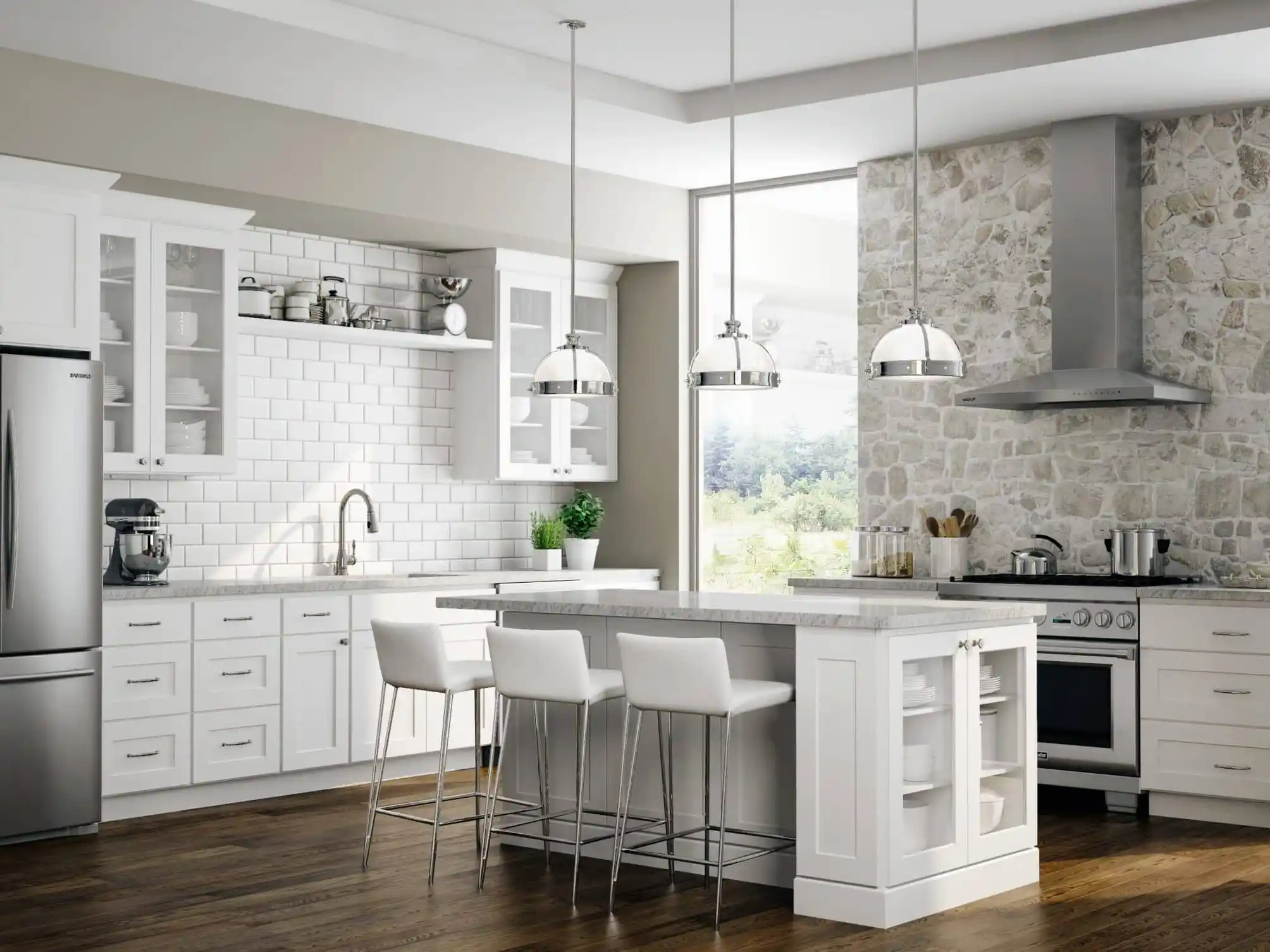
Many stock systems use cabinet widths that increase in regular increments. Designers combine those cabinets with fillers, panels, trim, and appliance openings to complete the layout. This system keeps manufacturing efficient and helps stock cabinets remain more affordable and easier to obtain than products requiring extensive modification.
Stock does not necessarily mean a cabinet is sitting fully assembled in a warehouse. Some stock lines are produced or assembled after an order is placed, while others are available as ready-to-assemble cabinets. The meaningful distinction is that the buyer is selecting from a predefined product system rather than substantially changing the cabinet dimensions or specifications.
Where Stock Cabinets Work Well
Stock cabinetry works best when the kitchen has relatively straightforward dimensions and the available cabinet sizes fit the layout without creating awkward gaps. A standard L-shaped, galley, or simple U-shaped kitchen can often be designed successfully with stock cabinets when windows, appliances, plumbing, and corners line up favorably.
They can also make sense when budget or schedule is more important than having a specific custom paint color or unusual cabinet dimension. Good kitchen design still matters. Careful use of fillers, end panels, drawer bases, pantry cabinets, and accessories can make a stock kitchen look far more intentional than simply filling the walls with whatever cabinet widths happen to fit.
Where Stock Cabinets Become Limiting
The limitations usually become noticeable when a room contains unusual dimensions or when the homeowner wants something outside the manufacturer’s catalog. A narrow leftover space may require a larger filler because the cabinet cannot be made one or two inches wider. Tall ceilings may leave an awkward gap if the available wall cabinet heights do not fit the room well.
Finish selection can also be more limited. If a particular door style is available in only a small number of paints or stains, the surrounding countertop, backsplash, flooring, and hardware have to work around those choices rather than the other way around.
What Are Semi-Custom Cabinets?
Semi-custom cabinets are built from a manufacturer’s established cabinet system but offer significantly more flexibility than most stock lines. The manufacturer still determines the basic cabinet construction, door program, materials, and available options, but the designer usually has access to more widths, heights, depths, finishes, accessories, and selected modifications.
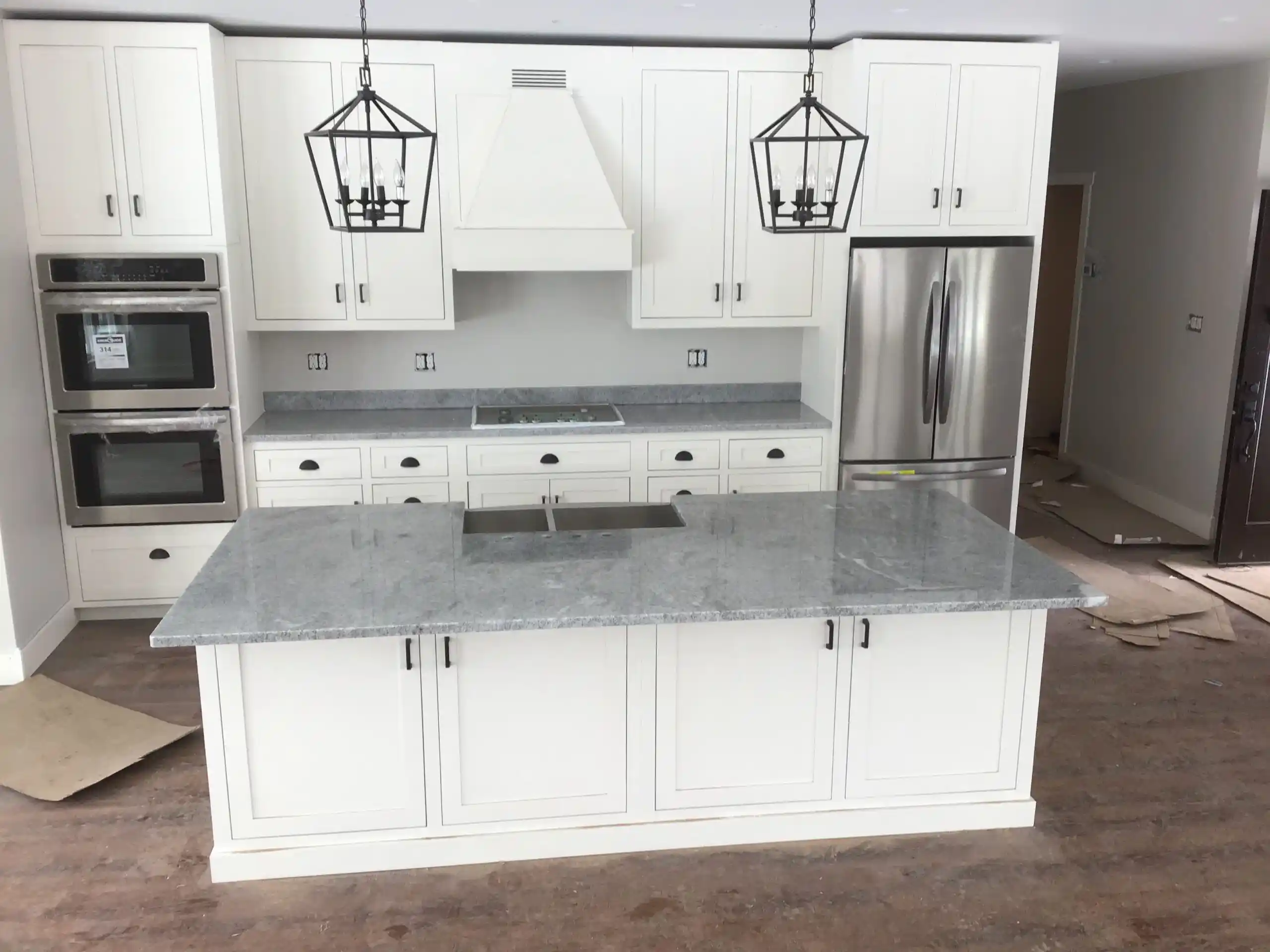
We often describe semi-custom as customizing within a system. You are not designing every cabinet from a blank sheet of paper, but you have enough control to solve many of the fit and design problems that appear in real kitchens.
For many remodeling projects, this level of flexibility is useful because homeowners can improve the fit without paying for unrestricted customization in every cabinet.
What Can Usually Be Changed with Semi-Custom Cabinets?
The exact modification program varies by manufacturer, but semi-custom lines may offer reduced or increased depths, more cabinet widths, extended stiles, altered heights, finished interiors, decorative ends, glass doors, furniture details, specialty storage, and a much broader finish program.
This can significantly reduce compromises in the layout. Instead of filling an unusual space with a wide filler, the designer may be able to modify a cabinet dimension or choose from smaller size increments. A refrigerator surround may be adjusted more precisely, or an upper cabinet may be sized to relate better to the ceiling and crown molding.
The important word is may. Semi-custom does not mean every dimension can be changed. Each manufacturer defines what modifications are permitted, so we check the actual cabinet line before designing around a feature that may not be available.
Why Semi-Custom Works for Many Kitchen Remodels
Most kitchens need some flexibility, but relatively few require every cabinet to be individually fabricated. Semi-custom fills that gap well. It provides more control over appearance and sizing while retaining the manufacturing efficiencies of a standardized cabinet system.
At Columbus Cabinets City, we look at whether the extra options solve meaningful problems. If a wider range of cabinet dimensions eliminates excessive fillers, if a deeper refrigerator cabinet improves the appliance wall, or if a particular finish helps coordinate the entire kitchen, the move from stock to semi-custom can be worthwhile.
What Are Custom Cabinets?
Custom cabinets are built specifically for the project rather than selected primarily from predetermined cabinet sizes. Dimensions, materials, door details, storage configurations, finishes, and architectural features can be developed around the room and the homeowner’s design requirements.
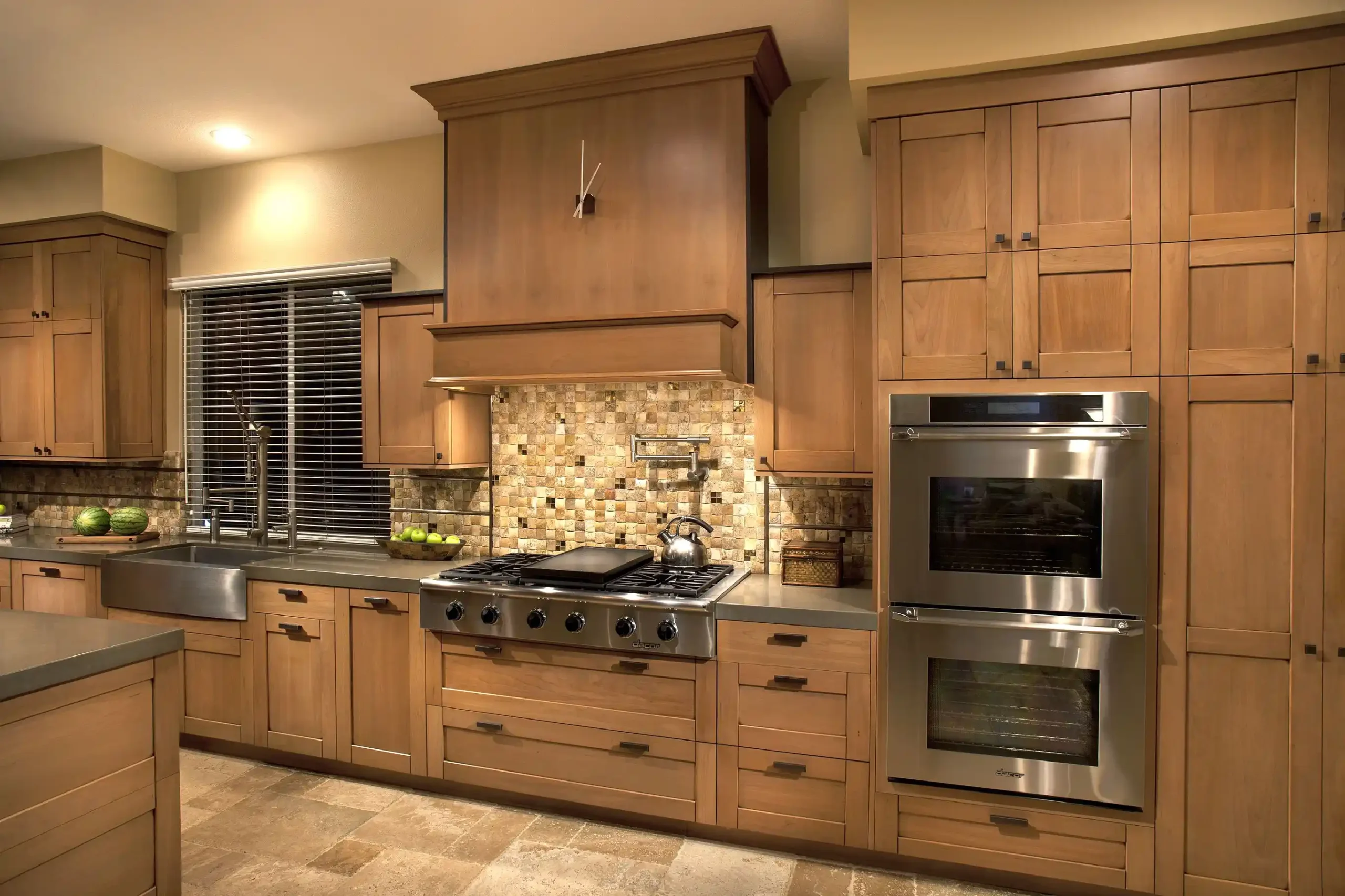
This gives the designer far more freedom, but that freedom should serve a purpose. Custom cabinetry makes the most sense when standard manufacturing systems would force significant compromises in fit, function, or appearance.
A custom kitchen may include cabinets sized precisely to unusual walls, specialized furniture-style pieces, uncommon wood species, custom finishes, unique door profiles, complex appliance integration, or storage developed around specific objects. The cabinetmaker or manufacturer determines what can realistically be produced.
What Custom Cabinetry Can Solve
Custom cabinets are particularly useful in rooms where standard dimensions repeatedly create problems. Older homes can have irregular walls, unusual ceiling conditions, narrow niches, sloped areas, or architectural details that do not align well with stock cabinet increments.
Custom construction can also solve deliberate design requirements. A homeowner may want a cabinet wall that ends at an exact architectural line, a furniture-style island with specific proportions, a highly specialized pantry, or a finish that does not exist in a manufacturer’s standard program.
In these cases, customization is not simply a luxury feature. It can be the most direct way to make the cabinetry fit the design correctly.
Stock, Semi-Custom, and Custom Describe Flexibility, Not Automatic Quality
One of the most important points when comparing cabinet categories is that stock, semi-custom, and custom do not function as universal quality grades. They mainly describe how much choice and modification are available.
A stock cabinet can include plywood construction, soft-close hardware, strong drawer boxes, and a durable finish. A semi-custom line may offer extensive design choices while using materials that are similar to another manufacturer’s stock product. A custom cabinet can be beautifully built, but quality still depends on the cabinetmaker, materials, joinery, hardware, finishing process, and installation.
When we compare cabinets at Columbus Cabinets City, we look past the category name and examine what is actually being supplied. That provides a much more useful basis for deciding whether the price difference is justified.
Cabinet Construction Differences
Cabinet construction can vary within every category. Stock, semi-custom, and custom cabinets may use framed or frameless boxes, different panel materials, different backs, and different methods of joining cabinet components.
This is where product specifications matter. If you are also comparing framed vs. frameless cabinets, treat that as a separate decision from stock vs. custom. A frameless cabinet can be stock, semi-custom, or custom, just as a face-frame cabinet can exist at several levels of customization.
Look at box thickness, backs, shelves, drawer construction, hinges, slides, and joinery rather than assuming a cabinet becomes structurally superior simply because it carries a custom label.
Materials: What Actually Changes?
Cabinet materials do not divide neatly into three categories either. Stock cabinets may use engineered panels, plywood, MDF, hardwood components, or combinations of them. Semi-custom products may offer upgrades or different construction packages. Custom cabinetry can provide greater freedom in wood species and material selection, but the actual specification still needs to be reviewed.
Door material also deserves separate attention. Painted cabinetry may use MDF or HDF because those materials can create a smooth, stable painted surface. Stained cabinetry may use hardwood or veneer where natural grain is important.
The better question is not, “Is this stock or custom?” It is, “What is each part of this cabinet made from, and is that material appropriate for how the cabinet is being used?”
Cabinet Sizes and Layout Flexibility
Sizing is one of the clearest differences between the three categories. Stock cabinetry usually gives the designer a fixed menu of widths, heights, and depths. Semi-custom expands that menu and may allow specific dimensional modifications. Custom cabinetry can be built around dimensions that fall outside a standard product program.
That flexibility becomes important when working around windows, appliances, corners, ceiling height, or walls that do not divide neatly into standard cabinet widths. Accurate room dimensions should come first. Our process for how to measure kitchen cabinets is important because even the most flexible cabinet system can only be designed correctly when the room itself has been measured properly.
Why Fillers Matter in Stock Kitchens
Fillers are not inherently a sign of poor design. Cabinets need clearance beside walls, corners, appliances, and uneven surfaces, so some filler space can be necessary regardless of cabinet category.
The issue is how much filler is being used. If a stock cabinet line leaves several inches unused simply because the next available cabinet size will not fit, a semi-custom modification may provide more functional storage. Custom cabinetry can go further by sizing the cabinet specifically for the available opening.
We evaluate whether reducing filler space actually improves the kitchen enough to justify moving to a more flexible cabinet line.
Door Styles and Finishes
Stock cabinets usually offer a focused collection of popular door styles and finishes. That can be an advantage for homeowners who already like one of those combinations because there is little value in paying for hundreds of options when the preferred cabinet is already available.
Semi-custom expands the design vocabulary. More paint colors, stains, wood species, door profiles, glazes, decorative options, and finish combinations may be available. Custom cabinetry removes even more restrictions and may allow project-specific profiles or colors.
More choices are useful only when you need them. A homeowner who wants a standard white Shaker kitchen may gain very little from an enormous custom finish program. Someone trying to match existing millwork or achieve a specific wood tone may gain a great deal.
Storage Options and Cabinet Accessories
Modern stock cabinet lines can offer much more storage functionality than older perceptions of stock cabinetry suggest. Drawer bases, trash pull-outs, roll-out trays, Lazy Susans, pantry cabinets with pull-outs, organizers, and soft-close hardware can be available without moving into full custom construction.
Semi-custom lines generally broaden those choices and may allow more configuration options. Custom cabinetry becomes valuable when storage must be designed around something unusual, such as a specific appliance collection, a very narrow architectural opening, specialized pantry requirements, or a piece of equipment that does not fit standard organizers.
We recommend starting with the storage problem rather than the product category. If a standard accessory solves it well, custom fabrication may add expense without improving everyday use.
Which Type Gives You the Best Use of Space?
Custom cabinets offer the greatest theoretical ability to use every available inch, but that does not mean every kitchen needs them. Good semi-custom design can use space extremely efficiently, and a well-planned stock kitchen can outperform a poorly designed custom one.
The biggest opportunities usually come from cabinet configuration. Wide drawers can be more useful than multiple narrow door cabinets. A pantry with interior roll-outs can outperform deep fixed shelves. A good corner solution can matter more than gaining another inch of cabinet width.
Cabinet category affects the designer’s toolkit. It does not replace thoughtful space planning.
Stock vs. Semi-Custom vs. Custom Cabinet Cost
In general, stock cabinets have the lowest starting cost, semi-custom cabinets occupy the middle and upper-middle range, and custom cabinetry has the highest cost. The progression reflects more than material. Additional engineering, finish choices, modifications, labor, production complexity, and project-specific fabrication all contribute to the difference.
We recommend comparing complete quotes rather than relying too heavily on a cost-per-linear-foot figure. Our guide to kitchen cabinet costs explains the main budget components. One quote may include finished panels, crown molding, soft-close drawers, organizers, delivery, assembly, and installation while another includes only basic cabinet boxes. Those are not equivalent prices even if both are described as a cost per linear foot.
Why Stock Cabinets Cost Less
Stock manufacturing limits variation. The manufacturer can produce repeated cabinet sizes, finishes, and components efficiently, which reduces the amount of project-specific engineering and labor.
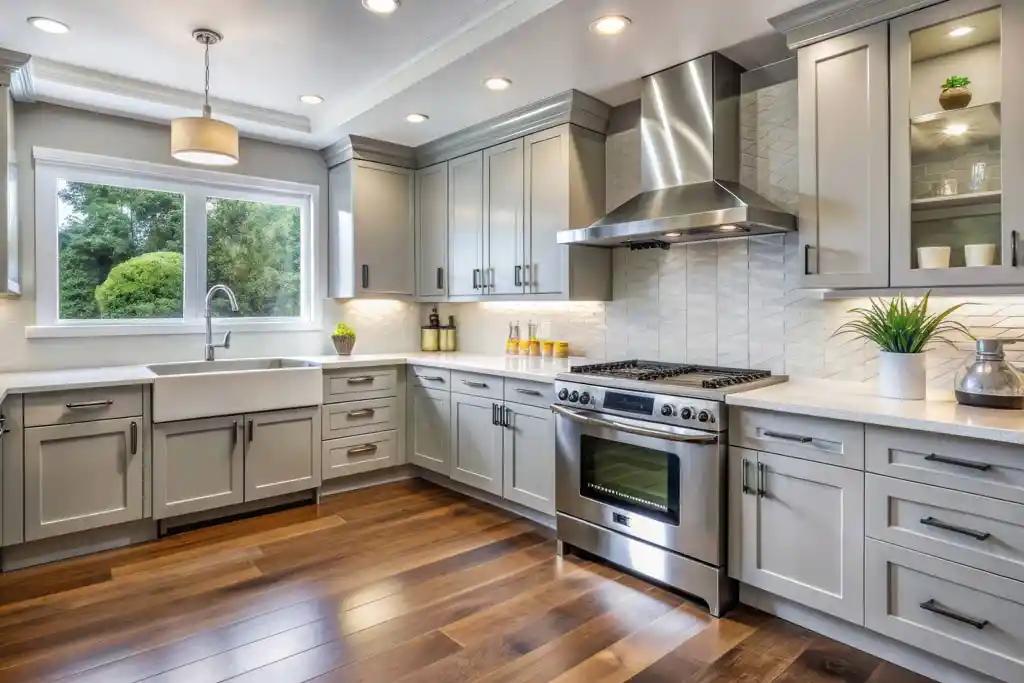
The lower price does not automatically mean the cabinets will perform poorly. It means the homeowner accepts a narrower range of choices and the kitchen design works within that system.
For standard layouts, this can be a very efficient use of budget. Money that would have gone toward dimensional customization can instead be used for better countertops, storage accessories, appliances, flooring, or other parts of the kitchen.
Why Semi-Custom Costs More
Semi-custom cabinetry introduces more variables into manufacturing. More door styles, finishes, cabinet sizes, accessories, and permitted modifications increase both production complexity and the amount of design work involved.
The additional cost makes the most sense when those options improve something tangible. If a depth modification makes a refrigerator wall work properly or a cabinet-size adjustment eliminates unnecessary filler, the upgrade has functional value.
Paying more simply to access a larger catalog is less compelling when the stock line already offers the exact cabinet style and layout the homeowner wants.
Why Custom Cabinets Cost More
Custom cabinetry requires more project-specific work. Cabinets may need to be individually engineered, fabricated, finished, and fitted for the room. Unusual materials, specialty finishes, unique door profiles, or complex architectural details add further labor.
Installation can also demand greater precision because the cabinetry may be designed to align closely with walls, ceilings, paneling, appliances, or architectural trim.
That additional cost is easiest to justify when custom work solves a real design problem or creates something unavailable through semi-custom cabinetry.
Lead Time and Project Scheduling
Stock cabinetry generally offers the shortest path from selection to delivery because the product choices and dimensions are already established. Some lines may be available quickly, while others are produced or assembled after ordering.
Semi-custom usually requires more production time because the kitchen is being manufactured after selections and modifications have been finalized. Custom cabinetry generally takes the longest because fabrication is more project-specific.
Lead times can change by manufacturer, finish, season, supply conditions, and order complexity. We therefore treat current production schedules as something to verify when the kitchen is ordered rather than assuming one universal number applies to an entire cabinet category.
Installation Differences
No cabinet category eliminates the need for accurate installation. Review the steps in installing kitchen cabinets when planning the work. Stock cabinets may require more filler and scribe work when standard boxes meet imperfect walls. Semi-custom can sometimes reduce those compromises through better sizing. Custom cabinets can fit architectural conditions more precisely, but tighter tolerances can also make accurate field measurements and installation even more important.
The walls themselves still matter. A cabinet built to an exact dimension cannot correct a wall that was measured incorrectly or an appliance specification that changed after production. Final measurements, flooring conditions, ceiling height, utilities, and appliance details should be confirmed before cabinets are released for manufacturing.
Stock Cabinets for Standard Kitchens
A straightforward kitchen is where stock cabinetry can offer excellent value. If the available sizes line up cleanly with the walls, appliances, windows, and corners, there may be little benefit in paying for dimensional flexibility that the room does not require.
This is especially true when the homeowner already likes a stock door style and finish. The project can remain focused on layout, storage, countertops, lighting, and installation rather than increasing the budget simply to move into another cabinet category.
The important question is whether the design feels intentional after working within the available sizes.
Semi-Custom Cabinets for Remodels
Remodeling often introduces conditions that make semi-custom cabinetry particularly useful. Existing walls may be slightly irregular, appliances may have specific panel or clearance requirements, and homeowners may want to improve storage without completely departing from standard cabinet construction.
Semi-custom gives the designer more tools for resolving those conditions. Additional widths, height choices, depth modifications, finish options, and accessories can improve fit without requiring every cabinet to become a one-off product.
For many kitchens, the practical decision is not whether custom is “better.” It is whether semi-custom already provides enough flexibility to accomplish the design properly.
When Custom Cabinets Are Worth It
Custom cabinetry becomes worthwhile when its flexibility is actually being used. Unusual architecture is one of the clearest examples. Sloped ceilings, difficult wall dimensions, highly specific built-ins, historical details, and cabinetry that must integrate closely with architectural millwork can justify project-specific fabrication.
Design requirements can create the same need. A distinctive furniture-style island, a particular door profile, unusual wood species, bookmatched veneer, a highly specific finish, or specialized storage may not exist within a semi-custom program.
If the desired kitchen can already be built cleanly with semi-custom cabinetry, paying for full customization may provide little additional value.
When Custom Cabinets May Be Unnecessary
Custom cabinets can be unnecessary when the kitchen is straightforward and the desired style is already widely available. A standard-sized kitchen using a common Shaker door, familiar paint finish, typical appliances, and conventional storage may be handled very effectively by stock or semi-custom cabinetry.
We prefer to identify the problem custom cabinetry is solving before recommending the additional expense. If the answer is simply “custom sounds higher quality,” we go back to the actual specifications. Construction quality and customization are related in some product lines, but they are not the same thing.
Choosing Cabinets for an Older Home
Older homes can make cabinet selection more complicated because walls may not be square, ceilings may vary, and previous remodeling can leave unusual dimensions. Custom cabinetry can solve many of these conditions, but it should not automatically be the first choice.
A careful measurement and semi-custom design may handle the room perfectly well. Fillers, extended stiles, finished panels, molding, and cabinet modifications can absorb many irregularities.
We move toward custom when those techniques start creating too many compromises or when the cabinetry needs to follow architectural conditions that a standardized system cannot accommodate gracefully.
Choosing Cabinets for a Small Kitchen
In a small kitchen, every inch feels valuable, which can make custom cabinetry attractive. However, cabinet size is only part of efficient storage. Drawer configuration, corner planning, pantry design, appliance placement, and vertical storage can have a larger effect on usability than eliminating every small filler.
Semi-custom can be particularly effective in compact kitchens because narrower size increments and selected modifications may recover useful space without moving to full custom fabrication.
We focus first on what needs to be stored and how the homeowner moves through the kitchen. Then we determine which cabinet level provides enough flexibility to support that plan.
Choosing Cabinets for a Large Kitchen
A large kitchen does not automatically require custom cabinets. In fact, standard dimensions may work easily because the room provides more flexibility for positioning cabinetry, islands, appliances, and fillers.
The reason to move toward semi-custom or custom in a larger kitchen is usually design ambition rather than basic fit. Homeowners may want furniture-style features, multiple finishes, oversized islands, elaborate appliance walls, specialty pantries, or architectural details that benefit from more customization.
The larger cabinet quantity also means upgrades affect the overall budget more significantly, so it is worth deciding where customization will actually be visible or useful.
Stock vs. Semi-Custom vs. Custom for Resale
If the kitchen is being improved primarily for resale, the most expensive cabinet category is not automatically the best financial decision. Buyers experience the finished kitchen, not simply the label attached to the cabinet program.
A well-designed stock or semi-custom kitchen with good storage, durable finishes, appealing countertops, proper lighting, and professional installation can present very strongly. Spending heavily on hidden customization may not return the same value if buyers cannot see or use the difference.
For a long-term home, personal preferences and specialized storage may justify more customization because the homeowner will benefit from those features every day.
How to Compare Cabinet Quotes Fairly
A low quote and a high quote may represent completely different products even when both use the same kitchen drawing. Before comparing prices, check what each proposal includes.
Look at cabinet box material, door construction, finished ends, drawer boxes, hinges, slides, cabinet modifications, decorative panels, fillers, trim, crown molding, organizers, assembly, delivery, and installation. Also check whether tax, demolition, hardware, and installation are included.
A fair comparison requires matching scope as closely as possible. Otherwise, a stock quote containing only basic cabinetry can appear dramatically cheaper than a semi-custom proposal that already includes upgrades and finishing components.
Which Is Better: Stock, Semi-Custom, or Custom Cabinets?
There is no universal winner. The best cabinet category is the least expensive level that can deliver the layout, appearance, construction, and storage you actually want without creating unnecessary compromises.
Choose stock cabinets when the room fits standard sizes well, the available styles work for your design, budget matters, and extensive modifications are unnecessary.
Choose semi-custom cabinets when you need more control over sizing, finishes, storage, or details but still want the efficiency of a manufacturer-based cabinet system.
Choose custom cabinets when unusual dimensions, architectural conditions, specialized storage, materials, finishes, or design features cannot be handled properly within a semi-custom program.
That decision framework is more useful than simply choosing the highest cabinet tier the budget allows.
Common Mistakes When Choosing a Cabinet Level
One common mistake is assuming custom automatically means the best construction. Another is choosing stock solely because the initial price is lower without checking how much filler, compromise, or lost storage the layout will require. Homeowners can also overspend on semi-custom options they never actually use.
The better approach is to design the kitchen first and identify where the constraints occur. If the standard cabinet system handles those conditions cleanly, keep it. If additional sizing or finish flexibility solves meaningful problems, consider semi-custom. Move to full custom when the project genuinely benefits from unrestricted fabrication.
Choose the Cabinet Level Around the Kitchen, Not the Label
Stock, semi-custom, and custom cabinets are three different ways of approaching the same kitchen. Stock works within a defined product system, semi-custom expands that system, and custom allows the cabinetry to be developed around the project itself. Each can be the right choice when it matches the room, design goals, budget, and level of flexibility required.
At Columbus Cabinets City, we prefer to determine what the kitchen actually needs before deciding which category makes sense. Explore our kitchen cabinetry options as you compare available products. Cabinet dimensions, appliances, storage, materials, finishes, construction, and overall layout all matter. Once those priorities are clear, it becomes much easier to see whether stock cabinetry is enough, semi-custom provides the right balance, or custom construction will genuinely improve the finished kitchen.
Frequently Asked Questions About Stock, Semi-Custom, and Custom Cabinets
Stock cabinets use predetermined sizes and options. Semi-custom cabinets use a manufacturer’s standard system but provide more sizes, finishes, accessories, and selected modifications. Custom cabinets are built specifically around the project’s dimensions and design requirements.
The major difference is flexibility, not automatically quality.
Not necessarily. Semi-custom cabinets provide more choices and modification options, but a well-built stock cabinet can still offer strong materials, good hardware, and durable construction.
Semi-custom becomes better when its additional sizing, finish, or storage options solve something that cannot be handled effectively with the stock line.
Custom cabinets can be extremely well built, but the word custom does not guarantee quality. Construction depends on the materials, cabinetmaker, joinery, hardware, finishing process, and installation.
Always evaluate the actual specifications rather than relying on the category name alone.
No. Stock describes the limited sizing and option system, not a specific quality standard. Stock cabinetry ranges from economy products to better-built lines with plywood boxes, quality hardware, strong drawers, and durable finishes.
Yes. Careful layout planning, finished panels, appropriate fillers, crown molding, coordinated hardware, good countertops, and thoughtful storage can make stock cabinetry look highly finished.
The room needs to work well with the available cabinet sizes for the result to feel intentional.
Semi-custom cabinets are manufactured from a predefined cabinet system but offer more choices than stock cabinetry. Depending on the manufacturer, this may include additional widths, depth modifications, more door styles, broader finish selections, specialty storage, and decorative options.
Custom cabinets make sense when the kitchen has unusual dimensions or when you need a feature that stock and semi-custom programs cannot provide. Examples include difficult architecture, highly specialized storage, unusual materials, project-specific finishes, and cabinetry that must match precise architectural details.
They can be when the additional flexibility improves the kitchen. If semi-custom sizing reduces wasted filler, improves an appliance wall, provides a needed cabinet depth, or gives you a finish unavailable in stock cabinetry, the extra cost has a clear benefit.
If the stock line already gives you exactly what you need, the upgrade may not be necessary.
There is no single best category for remodeling. Stock works well for straightforward layouts, semi-custom provides useful flexibility for many remodeling conditions, and custom becomes valuable when unusual architecture or specialized design requirements cannot be solved effectively with standard systems.
Usually, yes. Custom cabinetry generally requires more project-specific engineering, fabrication, and finishing than standard stock products. Semi-custom also typically takes longer than readily available stock cabinetry. Actual lead times vary by manufacturer, finish, order size, and current production schedule.
Usually not. Semi-custom manufacturers provide specific modifications and dimensional options within their cabinet program. The allowed changes vary considerably between manufacturers.
If a cabinet must be built to an exact unusual dimension that falls outside those modification rules, custom cabinetry may be required.
The best value is usually the cabinet level that provides everything the kitchen genuinely needs without paying for unused flexibility. For one project that may be stock. For another, semi-custom modifications may produce a noticeably better layout. Complex kitchens may gain enough from custom fabrication to justify the higher investment.