Quartz countertops cost can vary significantly from one kitchen to another, even when the countertops appear similar at first glance. For early budgeting, homeowners can often use a broad planning range of about $50 to $150 per square foot installed, while premium quartz, complex fabrication, waterfall islands, specialty edges, difficult layouts, and other upgrades can push the final cost higher.
At Columbus Cabinets City, we recommend looking beyond the basic square-foot price when planning a quartz countertop project. The quartz color, veining, pattern, slab size, thickness, edge profile, sink and cooktop cutouts, seams, backsplash, countertop layout, removal of old materials, and installation conditions can all change the final quote.
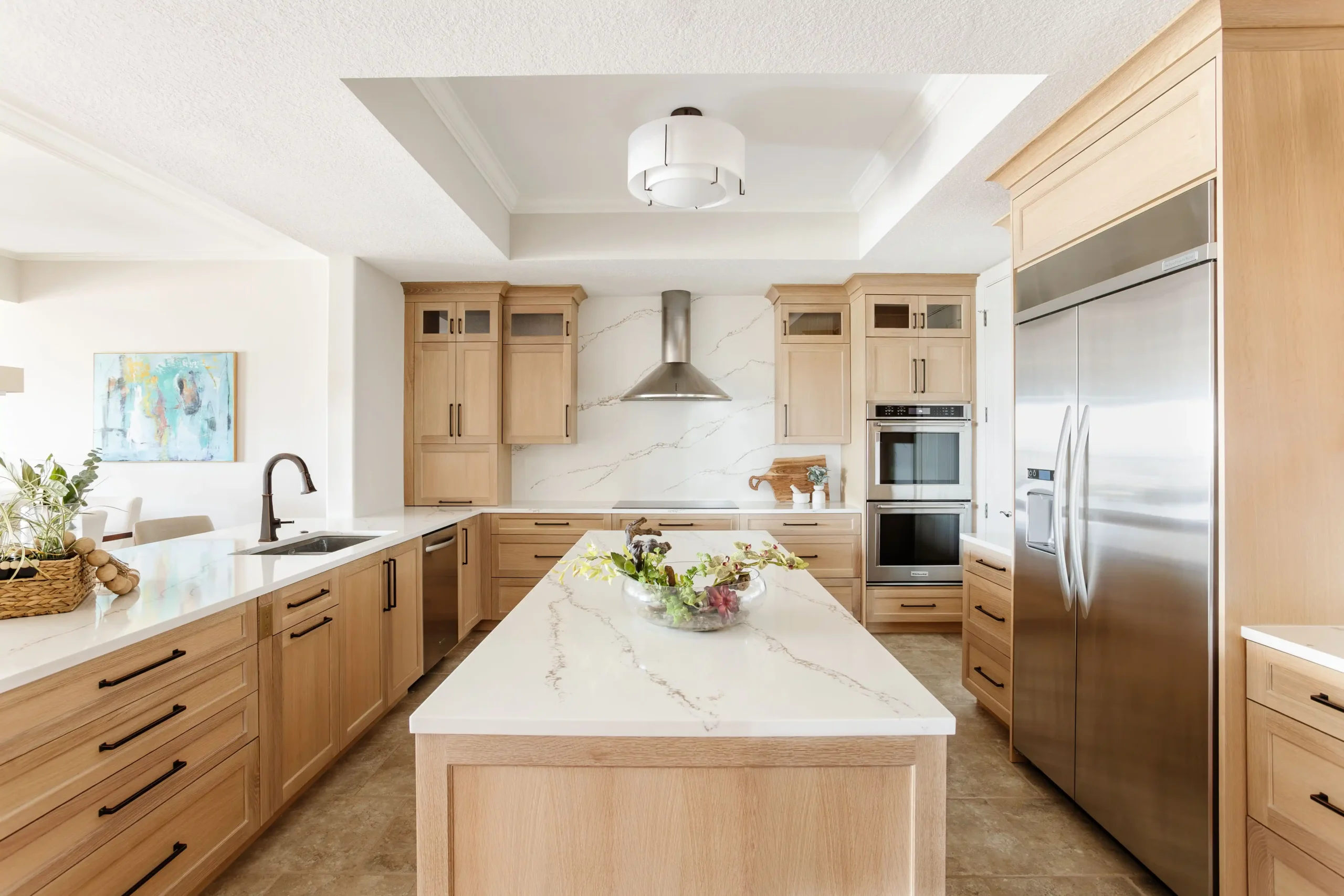
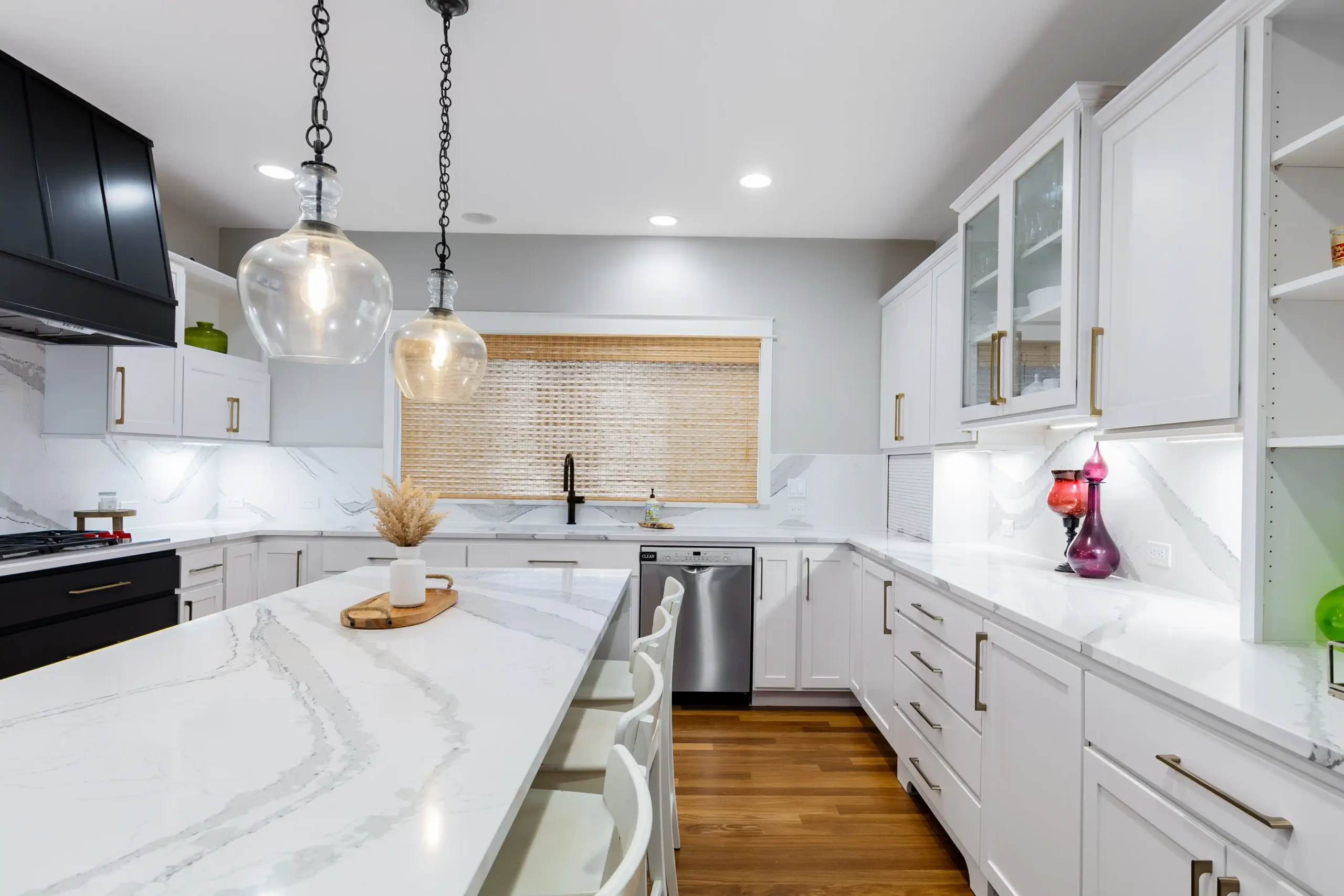
A simple straight countertop with a standard edge will usually cost less than an L-shaped or U-shaped kitchen using dramatic Calacatta-style quartz with multiple seams and cutouts. A large island with waterfall panels can also require considerably more quartz than its horizontal surface alone suggests.
In this guide, we explain how much quartz countertops cost, quartz countertop installation costs, quartz countertop cost per square foot, the cost of a 10-foot countertop, and how design choices such as veining, thickness, finish, edges, islands, and kitchen layout affect the final price.
How Much Do Quartz Countertops Cost?
For early planning, quartz countertops commonly fall around $50 to $150 per square foot when fabrication and professional installation are included. A straightforward project using an entry-level or mid-range quartz with standard fabrication will generally sit closer to the lower or middle part of that range, while premium designs, complex layouts, specialty fabrication, and high-end installations can move beyond it.
That means a 40-square-foot quartz countertop project might roughly fall between $2,000 and $6,000 before unusual site conditions or premium upgrades are considered. A 50-square-foot project could roughly fall between $2,500 and $7,500. We treat these figures as budgeting tools rather than quotes because the actual slab selection and fabrication plan matter just as much as the total square footage.
| Countertop Size | Early Installed Cost Planning Range |
| 20 sq. ft. | $1,000–$3,000 |
| 30 sq. ft. | $1,500–$4,500 |
| 40 sq. ft. | $2,000–$6,000 |
| 50 sq. ft. | $2,500–$7,500 |
| 60 sq. ft. | $3,000–$9,000 |
| 70 sq. ft. | $3,500–$10,500 |
These estimates are most useful before a countertop has been selected. Once we know the exact quartz, dimensions, edge, cutouts, backsplash requirements, and layout, a project-specific estimate becomes much more meaningful.
Quartz Countertop Per Square Foot Cost
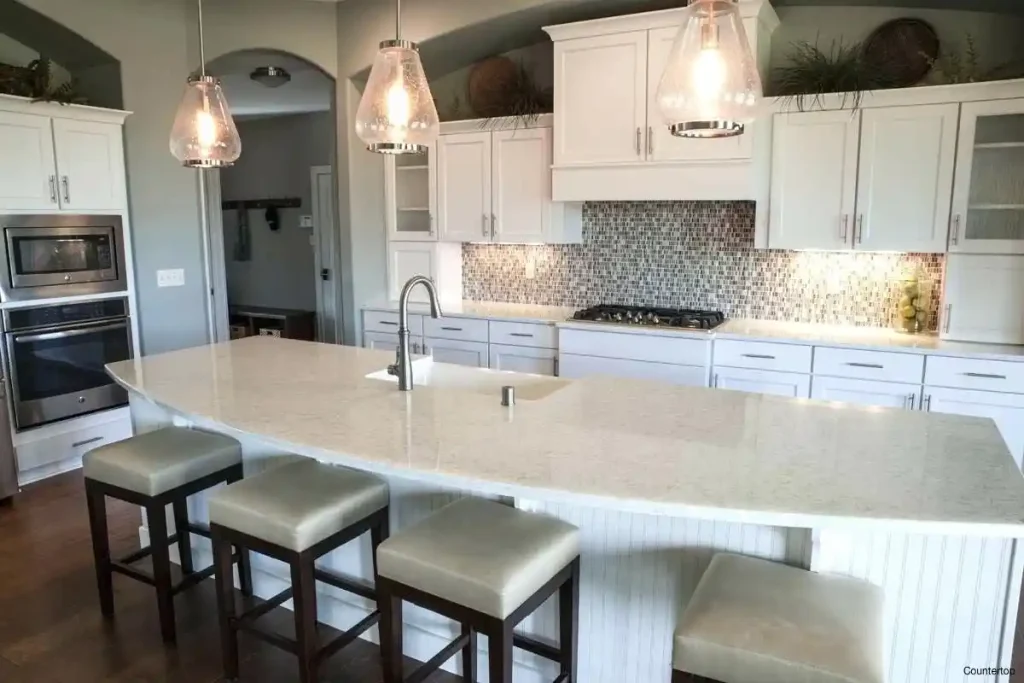
Quartz countertop per square foot cost is usually the first number homeowners compare, but it is also one of the easiest numbers to misunderstand. Some advertised prices refer primarily to the material, while others include templating, fabrication, a standard edge, delivery, and installation. Always confirm exactly what is included before comparing two quartz countertop prices.
For general budgeting, we like to think about quartz in three broad price levels. These are not fixed product grades, because every manufacturer and fabricator structures pricing differently, but they provide a useful way to understand why one quartz option can cost considerably more than another.
Entry-Level Quartz Cost
Entry-level quartz typically uses simpler colors, more consistent patterns, and widely available designs. White, gray, beige, lightly speckled, and relatively uniform surfaces are common in this category. Installed pricing may begin around the lower end of the $50 to $150 per-square-foot planning range when the layout and fabrication are straightforward.
Choosing an entry-level quartz does not mean the kitchen has to look inexpensive. A simple quartz paired with well-designed cabinetry, a clean edge, and a coordinated backsplash can produce a very polished finished kitchen.
Mid-Range Quartz Cost
Mid-range quartz gives homeowners more choices in veining, movement, marble-inspired designs, and color variation. Many of the popular Carrara- and Calacatta-inspired looks fall somewhere in the middle or upper-middle portion of the market depending on the manufacturer and specific collection.
This is where we often recommend comparing several physical samples because two white quartz countertops can have very different pricing once the veining, design technology, slab size, and brand are considered.
Premium Quartz Cost
Premium quartz typically includes more complex patterns, dramatic veining, specialty colors, larger slab formats, designer collections, or surfaces designed to closely imitate high-end natural stone. These options can reach or exceed the upper end of the standard installed price range.
Premium quartz also becomes more expensive when the design requires careful vein alignment across seams, a waterfall island, full-height backsplash panels, or multiple slabs from the same production batch.
What Is Included in Quartz Countertop Cost?
A complete quartz countertop quote can include much more than the raw slab. When we help plan countertop projects, we recommend looking at the entire scope rather than comparing only the advertised square-foot number. A more complete quote may include measurement or digital templating, quartz material, fabrication, edge finishing, basic cutouts, delivery, installation, seam work, and final fitting.
Other items may be listed separately depending on the project and fabricator. Sink cutouts, cooktop cutouts, faucet holes, upgraded edges, backsplash fabrication, waterfall panels, demolition, plumbing reconnection, difficult access, and additional seam work are common examples. Ask for an itemized quote so you understand what is included before comparing prices.
Quartz Countertop Installation Costs
Quartz countertop installation costs depend on the weight and size of the pieces, the number of seams, site access, cabinet condition, cutouts, layout, and amount of fitting required. Installation is much easier when the base cabinets are level, secure, and ready to receive the stone. Uneven cabinetry or unusual site conditions can create additional preparation work before quartz can be installed correctly.
The installation portion should also be considered together with fabrication because quartz is normally templated and cut before it arrives at the kitchen. The installers then position the pieces, create or finish seams, secure the countertop, make final adjustments, and verify that sink, cooktop, wall, and cabinet relationships are correct.
Countertop Templating Cost
Templating is the process of capturing the exact countertop dimensions after the cabinets are installed and properly positioned. Depending on the company, templating may be included within the overall fabrication price or listed separately.
Accurate templating is particularly important for L-shaped counters, U-shaped kitchens, irregular walls, islands, and projects where countertops must fit closely between finished surfaces.
Fabrication Cost
Fabrication includes cutting the quartz slab into the required countertop pieces and completing details such as sink openings, cooktop openings, faucet holes, edge profiles, and seam preparation. More complex fabrication generally means more labor and equipment time.
A straight countertop with one simple sink opening is easier to fabricate than a kitchen containing several corners, multiple cutouts, decorative edges, waterfall panels, and carefully aligned veins.
Delivery Cost
Delivery may be included in an installed countertop package or charged separately. Large quartz pieces are heavy and require specialized handling, particularly when installers need to navigate stairs, narrow doors, tight corners, elevators, or difficult exterior access.
An oversized island slab can also require additional installers or handling equipment, which may affect project cost.
Old Countertop Removal
If existing countertops need to be removed and disposed of, include this work in the project budget. Removal cost depends on the existing countertop material, size, attachment method, disposal requirements, and whether the cabinets need repairs afterward.
We recommend deciding who is responsible for removal before installation day so the cabinets are ready when the quartz installers arrive.
What Affects the Cost of Quartz Countertops?
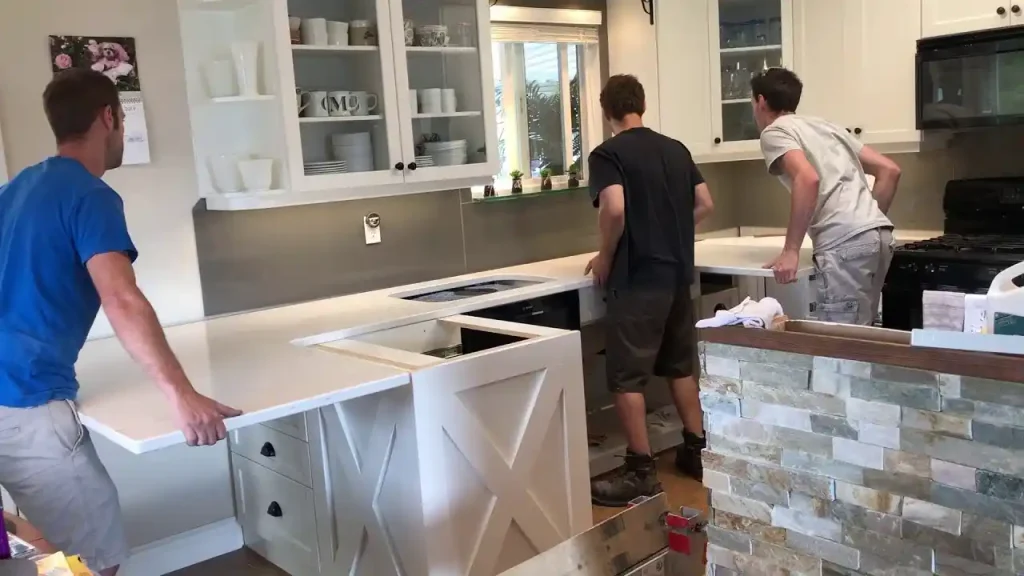
Square footage is only one part of quartz countertop pricing. Two kitchens with exactly 50 square feet of countertop can have very different final costs because the quartz designs, slab requirements, edge profiles, cutouts, layout, and fabrication details may be completely different.
When we review countertop options, we look at all of these factors together. This provides a much more realistic budget than selecting a quartz based only on a small sample and multiplying its advertised price by the countertop square footage. It also helps to understand the pros and cons of each countertop type before committing to quartz.
Quartz Brand and Collection
Quartz manufacturers typically organize their products into different collections or price groups. A simple solid color may sit in a lower tier, while a premium marble-inspired design with dramatic movement may be priced considerably higher.
Do not assume that all quartz from the same manufacturer costs the same. Specific designs and collections can have significantly different prices.
Quartz Color
Common quartz colors such as basic white, gray, beige, and simple neutrals may be available at lower price points because they are widely produced. Specialty colors or complex combinations may sit in more expensive product groups.
Color alone does not determine price, but it often works together with pattern complexity and the specific collection. If you are still narrowing down shades, our guide to choosing the right countertop color can help you compare options before pricing them.
Veining
Veining can have a noticeable impact on quartz countertop cost. Fine, repetitive veins may be available in more affordable collections, while large dramatic Calacatta-style veins and realistic natural-stone-inspired designs are frequently positioned in premium tiers.
Veining can also affect fabrication cost. When a homeowner wants the veins to flow naturally across a seam, backsplash, or waterfall edge, the fabricator may need to use more material or plan cuts differently.
Pattern and Movement
Quartz with a quiet, repetitive pattern is generally easier to lay out than a surface with large directional movement. Dramatic movement requires careful planning so the most attractive parts of the slab appear in visible areas and the pattern does not look interrupted at seams.
A directional quartz may also create more waste because pieces cannot always be rotated freely during fabrication without changing the direction of the pattern.
Quartz Slab Size
Slab size matters because larger slabs can sometimes reduce the number of seams in a kitchen. They can also make it possible to fabricate a large island from one piece instead of joining two smaller pieces.
However, jumbo slabs may belong to specific quartz collections or require special handling. The final cost depends on the manufacturer, design, slab dimensions, and fabrication requirements rather than slab size alone.
Does Quartz Veining Increase the Cost?
Quartz veining can increase the price when the selected design belongs to a premium collection or when the veining requires careful layout and matching during fabrication. Bold Calacatta-style quartz often costs more than basic solid or lightly patterned quartz because the surface design is more complex and may be positioned as a higher-tier product.
Veining matters even more when it needs to continue across an island waterfall, backsplash, or seam. Creating a visually connected pattern may require additional slab material and produce more offcuts. In our view, this is an area where spending more can be worthwhile when the countertop is intended to become the main visual feature of the kitchen.
Does Quartz Color Affect the Price?
Quartz color can affect cost, but the relationship is not as simple as saying one color always costs more than another. Basic whites, grays, blacks, and neutral patterns are available across many pricing levels, while specialty colors and highly realistic stone-inspired designs may appear in premium collections.
Availability can also influence cost. A quartz design that is widely stocked locally may be easier to source than a special-order color. When choosing between similar designs, we recommend comparing the actual installed quote rather than assuming the darker, lighter, or more colorful option will automatically cost more. For design ideas, see these countertop colors that pair well with white cabinets.
How Pattern and Movement Affect Quartz Countertop Cost
Pattern and movement affect pricing both through the quartz product itself and through fabrication. A relatively uniform quartz allows the fabricator to position pieces efficiently because there is less concern about how the pattern transitions from one area to another. Large directional veins require considerably more planning.
Movement becomes especially important on islands, L-shaped counters, full-height backsplashes, and waterfall panels. If the design goal is to keep veins flowing in a particular direction, the fabricator may need to reserve certain parts of a slab for specific pieces. That can reduce material efficiency and increase the number of slabs required.
Quartz Countertop Thickness Cost
Quartz countertops are commonly available in different thicknesses, with approximately 2 cm and 3 cm being common slab options. A thicker slab uses more material and usually creates a more substantial appearance, while a thinner slab can create a lighter profile and may be used differently depending on the application and manufacturer.
We recommend choosing thickness based on the countertop design, cabinet style, support requirements, edge appearance, and available quartz collection rather than cost alone. Not every design is offered in every thickness, and fabrication requirements can differ between products. You can also review current countertop thickness trends to see which profiles homeowners are choosing.
2 cm Quartz Countertops
A 2 cm quartz slab creates a thinner countertop profile and may cost less than the equivalent design in a thicker slab when both versions are available. Depending on the installation, additional support or edge treatment may be required.
The final cost advantage therefore depends on the complete fabrication plan rather than material thickness alone.
3 cm Quartz Countertops
A 3 cm slab creates a thicker visual edge and is commonly used for kitchen countertops. It can provide a substantial appearance without requiring a built-up edge to create thickness.
Because more material is used, the slab itself may cost more than a comparable thinner version. Availability also depends on the specific quartz manufacturer and design.
Mitered Thick-Look Edges
A mitered edge can make a countertop appear much thicker than the slab itself. Instead of using a solid extra-thick slab, pieces are carefully fabricated and joined to create the appearance of a deep countertop edge.
This requires additional material, cutting, alignment, and finishing, so it generally costs more than a standard eased edge.
How Quartz Finish Affects Cost
Polished quartz is one of the most common finishes and is frequently the standard finish included with a quartz design. Some collections are also available in honed, matte, concrete, suede, or textured finishes. Specialty finishes may be priced differently or available only in particular colors and product lines.
The finish can also affect the way the color and pattern appear. A polished black quartz, for example, may look deeper and more reflective than the same general color in a matte finish. We recommend selecting the finish based on both appearance and manufacturer care recommendations rather than price alone.
Polished Quartz
Polished quartz creates a smooth, reflective surface and is commonly included as the standard factory finish. Because no additional specialty finish needs to be selected, polished quartz often represents the baseline price for a particular design.
It works well in traditional, transitional, and modern kitchens and can make veining appear more defined.
Honed or Matte Quartz
Honed and matte quartz have less reflection and can create a softer, more contemporary appearance. Availability varies by manufacturer, and a specialty finish may carry an additional cost depending on the collection.
Dark matte surfaces can also show fingerprints, oils, or marks differently than polished surfaces, so maintenance expectations should be considered before selection.
Quartz Countertop Edge Cost
The countertop edge is shaped and polished during fabrication, and the amount of work required depends on the profile. A simple eased or straight-style edge is often included in standard fabrication, while decorative profiles usually add cost based on the number of exposed linear feet. Current fabrication guides show upgraded edges commonly adding anywhere from a few dollars to $40 or more per linear foot depending on complexity.
Islands tend to have more exposed edge than perimeter countertops because several sides may need finishing. This means the same decorative profile can cost substantially more on a large island than on a short countertop run against a wall. To compare how each profile looks, browse our guide to popular countertop edge designs.
Eased Edge Cost
An eased edge has a simple square appearance with slightly softened corners. It is one of the most common quartz edge profiles and is often included within standard fabrication pricing.
For homeowners trying to control costs, an eased edge usually provides a clean appearance without paying for more complicated shaping.
Beveled Edge Cost
A beveled edge introduces an angled detail along the countertop edge. The additional fabrication can create an upgrade charge compared with a standard eased profile.
The exact price depends on the fabricator and how many linear feet of exposed edge need to be finished.
Bullnose Edge Cost
A bullnose or half-bullnose profile uses a rounded shape that requires additional machining and polishing. These profiles may be charged as upgrades.
The rounded appearance works particularly well in traditional and transitional kitchens and can soften the visual weight of a thicker countertop.
Ogee Edge Cost
An ogee edge uses a more decorative curved profile and typically requires more fabrication than a simple edge. It therefore tends to sit among the more expensive traditional edge upgrades.
We generally recommend using an ornate edge only when it supports the cabinet and kitchen style, rather than selecting it simply because it looks more elaborate.
Mitered Edge Cost
Mitered edges create the appearance of a thicker countertop and require precise cutting and joining. Because additional material and fabrication are involved, the cost is typically higher than a basic edge.
Mitered edges are especially popular on islands where the thicker profile becomes a visible design feature.
Quartz Waterfall Countertop Cost
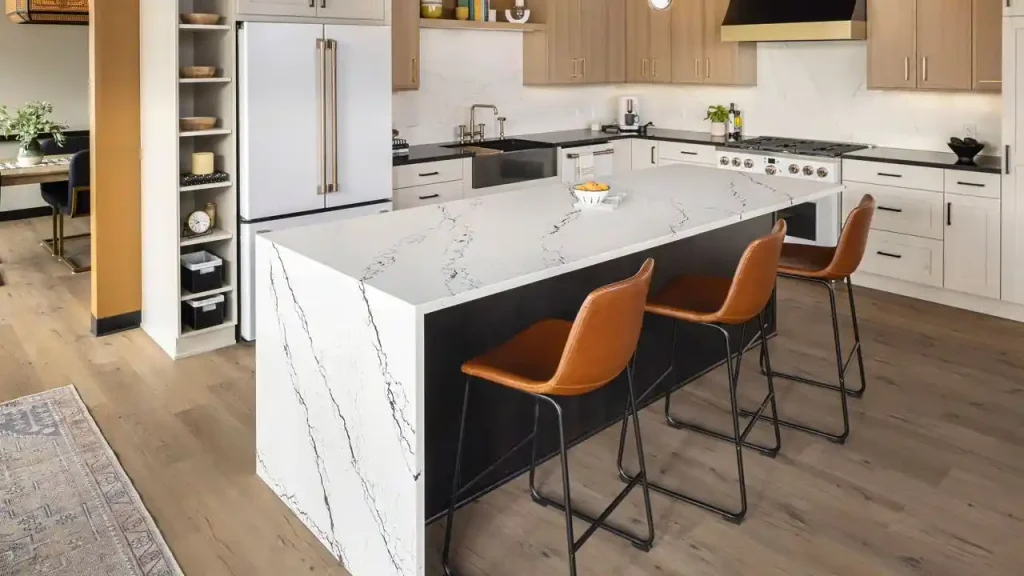
A waterfall countertop extends the quartz vertically down one or both sides of an island or cabinet instead of stopping at the horizontal surface. This adds considerable cost because the project requires additional slab material, precise mitered fabrication, vein alignment where applicable, and more installation work.
Current fabrication pricing research places waterfall fabrication alone around $50 to $100 or more per linear foot in some markets, while the extra slab panel means the actual project increase can easily reach hundreds or thousands of dollars per side depending on dimensions and quartz selection.
One-Sided Waterfall Island
A one-sided waterfall uses a vertical quartz panel at only one end of the island. This creates the waterfall effect while requiring less material than wrapping both ends.
It can be a good compromise when the exposed end of the island is a major focal point but the opposite side sits against another surface or is less visible.
Two-Sided Waterfall Island
A two-sided waterfall extends quartz down both exposed ends of the island. It creates a dramatic, furniture-like appearance but requires two additional vertical panels and precise fabrication.
When using quartz with strong veining, the fabricator may also need extra slab material to create visually continuous movement across both corners.
How Much Does a 10 Foot Quartz Countertop Cost?
The cost of a 10-foot quartz countertop depends on its depth because countertops are priced primarily by square footage rather than linear length. A standard kitchen countertop is often around 25 to 25½ inches deep. At approximately 25½ inches deep, a 10-foot straight countertop contains about 21 square feet of surface area.
Using a broad installed planning range of $50 to $150 per square foot, a basic 10-foot standard-depth quartz countertop might roughly fall between $1,050 and $3,200 before special edges, complex cutouts, premium quartz, demolition, or other upgrades are added. Minimum slab or fabrication charges can also make a small project cost more than simple square-foot math suggests.
10-Foot Standard Countertop Example
A 10-foot countertop at approximately 25½ inches deep works out to roughly 21.25 square feet.
At $50 per square foot, the planning estimate is around $1,060. At $100 per square foot, it is around $2,125. At $150 per square foot, it is around $3,190.
These are budgeting calculations, not project quotes.
10-Foot Kitchen Island Example
A 10-foot island is usually much deeper than a perimeter countertop. If the island is 36 inches wide, the horizontal surface alone is approximately 30 square feet.
At a $50 to $150 installed planning range, that works out to roughly $1,500 to $4,500 before waterfall panels, upgraded edges, sink or cooktop cutouts, additional support, or premium quartz are considered.
10-Foot Wide Island Example
If the same 10-foot island is 42 inches wide, it contains approximately 35 square feet of horizontal quartz.
Using the same planning range, the surface alone could roughly fall between $1,750 and $5,250. A waterfall end or large overhang can push the finished cost substantially higher.
Quartz Kitchen Island Cost
Kitchen islands often cost more per project than homeowners initially expect because an island can contain a large amount of quartz in one piece. Islands may also require more finished edges, larger slabs, polished sink cutouts, cooktop openings, overhang support, and difficult handling during installation.
The island design determines the cost more than the word “island” itself. A small 3-by-5-foot quartz island contains only 15 square feet of horizontal surface, while a 4-by-10-foot island contains 40 square feet before any waterfall panels are added. Planning the island cabinets and countertop together helps confirm the final size before the quartz is templated.
| Island Size | Approx. Surface Area | Planning Range at $50–$150/sq. ft. |
| 3′ × 5′ | 15 sq. ft. | $750–$2,250 |
| 3′ × 7′ | 21 sq. ft. | $1,050–$3,150 |
| 4′ × 6′ | 24 sq. ft. | $1,200–$3,600 |
| 4′ × 8′ | 32 sq. ft. | $1,600–$4,800 |
| 4′ × 10′ | 40 sq. ft. | $2,000–$6,000 |
These examples cover the horizontal countertop surface only and should not be used as a substitute for a fabrication quote.
Straight Kitchen Quartz Countertop Cost
A straight countertop run is usually one of the simplest quartz layouts to fabricate and install. There are fewer corners to template, fewer opportunities for seams, and the pieces can often be cut more efficiently from the slab. This makes a straight kitchen a useful baseline when comparing the cost impact of more complicated layouts.
The final price still depends on countertop length, quartz tier, edge profile, sink or cooktop cutouts, backsplash, and site access. A long straight run may also require a seam if the finished piece exceeds the usable slab length.
L-Shaped Quartz Countertop Cost
An L-shaped kitchen introduces an inside corner, which makes fabrication and installation more complicated than a simple straight run. The fabricator must determine how the two countertop sections will meet and where a seam should be placed if one is required.
L-shaped layouts may also create more slab waste depending on the pattern and dimensions. Dramatic directional quartz requires additional planning because the veins on the two sections should look intentional where the pieces meet.
Example L-Shaped Countertop
Imagine one countertop wall is 10 feet long and the adjoining wall is 8 feet long. If both are approximately 25½ inches deep, the rough surface area before adjusting for the overlapping corner is around 38 square feet.
Using a $50 to $150 per-square-foot planning range, the countertop portion might roughly fall between $1,900 and $5,700, with the actual price depending on slab use, cutouts, seams, edges, and quartz selection.
U-Shaped Quartz Countertop Cost
A U-shaped kitchen usually requires more countertop material and more fabrication than a straight or L-shaped layout because there are three connected countertop runs and two inside corners. This can mean additional seams, more complicated templating, and greater attention to pattern direction.
The price difference becomes especially noticeable when using quartz with large movement. The fabricator may need additional slab material so the pattern looks balanced across all three sides of the kitchen instead of appearing randomly cut.
Example U-Shaped Countertop
Consider a U-shaped kitchen with a 10-foot back run and two 8-foot side runs. At standard countertop depth, the rough surface area is approximately 55 square feet before adjusting for corner overlaps and appliances.
At $50 to $150 per square foot, an early planning range could be roughly $2,750 to $8,250 before premium edge work, special cutouts, backsplashes, demolition, or other upgrades.
Galley Kitchen Quartz Countertop Cost
A galley kitchen typically uses two opposing straight countertop runs. This layout can be relatively efficient because there are fewer inside corners than an L-shaped or U-shaped kitchen, although total square footage can still be substantial when both walls are long.
A galley design is also well suited to directional quartz because each run can often be planned independently. The number of sink and cooktop cutouts and whether long pieces require seams will influence the final fabrication price.
Quartz Backsplash Cost
Quartz can also be used as a backsplash, either as a short traditional backsplash or as a full-height slab extending from the countertop to the upper cabinets. A short backsplash uses relatively little additional material, while a full-height backsplash can add substantial square footage to the project.
Using the same quartz on both the countertop and backsplash can create a continuous appearance and is especially effective with dramatic veining. However, matching the vein pattern may require additional slabs or careful cutting, which can increase both material waste and fabrication cost. If you want to keep costs lower, tile backsplash options also pair well with quartz countertops.
4-Inch Quartz Backsplash
A short quartz backsplash uses strips fabricated from the countertop material and generally adds less cost than a full-height slab backsplash. It can also allow fabricators to use some remaining slab material efficiently depending on the layout.
Full-Height Quartz Backsplash
A full-height backsplash covers substantially more area and may require large carefully selected pieces. When the quartz contains strong movement, the placement of those pieces becomes an important design consideration. Full-height quartz backsplashes can therefore increase both material and installation costs significantly.
Sink Cutout Cost for Quartz Countertops
Sink cutouts require precise fabrication and can add to quartz countertop cost, particularly for undermount sinks where the inside edge of the opening must be carefully finished and polished. Current fabrication guides commonly place sink cutouts in roughly the $100 to $300 range, although pricing varies by fabricator, sink shape, and project.
Farmhouse or apron-front sinks can require additional cabinet and countertop planning because the sink position affects both the quartz cutout and the base cabinet. Confirm the exact sink model before final templating.
Cooktop Cutout Cost
A cooktop opening adds fabrication because the quartz must be cut to the appliance manufacturer’s specified dimensions. Straight rectangular cooktop openings are generally more straightforward than unusually shaped cutouts.
The countertop should be templated using the exact appliance specifications rather than approximate measurements. Changing the cooktop after quartz fabrication has started can create costly problems.
Faucet and Accessory Hole Costs
Faucet holes, soap dispensers, filtered-water faucets, air switches, and other countertop accessories may require additional drilling. Individual holes are generally inexpensive compared with a full sink cutout, but several accessories can add to the fabrication cost.
We recommend confirming every deck-mounted fixture before fabrication so the countertop arrives with the correct number and size of openings.
How Seams Affect Quartz Countertop Cost
Seams may be necessary when a countertop run exceeds slab dimensions, the kitchen contains difficult corners, or large pieces cannot be transported safely into the space. Every seam requires fabrication, alignment, adhesive, and finishing, so additional seams can increase labor cost.
Quartz with a uniform pattern is usually easier to seam visually than a surface with large directional veins. When pattern alignment is important, the fabricator may need to sacrifice more slab area to create a better visual transition.
How Much Does Quartz Countertop Removal Cost?
Removing existing countertops can add several hundred dollars to a project depending on the material, size, demolition difficulty, and disposal requirements. Lightweight laminate is generally easier to remove than thick stone countertops, tile set in mortar, or materials that were heavily adhered to the cabinetry.
Removal should also be coordinated carefully when existing cabinets will remain. Damaging the cabinet boxes during demolition can create additional repairs before the new quartz can be installed.
Cabinet Leveling and Quartz Countertop Cost
Quartz countertops need a properly prepared cabinet base. If cabinets are significantly out of level or poorly secured, they may need adjustment before templating or installation can proceed. This is especially important with long stone runs and large islands where small differences can create fitting problems.
At Columbus Cabinets City, we recommend resolving cabinet alignment before the countertop is measured. Correcting the cabinet installation first helps create a better foundation for accurate fabrication and avoids trying to solve cabinet problems with the countertop.
How Many Quartz Slabs Will I Need?
The number of slabs depends on countertop square footage, slab dimensions, kitchen layout, pattern direction, cutouts, and how efficiently the fabricator can nest the pieces. Dividing your countertop square footage by the slab square footage does not always provide the correct answer because pieces cannot always be arranged with zero waste.
Large islands, directional veins, U-shaped layouts, full-height backsplashes, and waterfall sides can increase slab requirements substantially. A fabrication layout is the best way to understand how much material your project actually needs.
Can Quartz Remnants Reduce the Cost?
Quartz remnants can be cost-effective for smaller projects such as bathroom vanities, laundry rooms, bar tops, desks, shower thresholds, or small countertop sections. A remnant is a usable piece left from a previously cut slab and may reduce the need to purchase or allocate a full slab.
For a complete kitchen, remnants are less practical because matching color, production batch, veining, and dimensions across multiple pieces can be difficult. We view remnants as a good opportunity for small complementary surfaces rather than the primary strategy for a large kitchen.
Is Quartz More Expensive Than Granite?
Quartz and granite pricing overlap significantly. Entry-level versions of either material can be relatively affordable, while premium quartz and rare or exotic granite can cost considerably more. The final comparison depends on the actual slabs being considered rather than on the material names alone. Our detailed guide to granite countertops cost breaks down natural stone pricing the same way. For a side-by-side breakdown, see our granite vs. quartz vs. marble cost comparison.
When homeowners compare quartz and granite with us, we recommend looking at the installed price of specific selections along with appearance, maintenance expectations, available colors, pattern consistency, and how the material works with the overall kitchen design. You can also explore our granite countertops to compare specific slabs.
How to Save Money on Quartz Countertops
The easiest way to reduce quartz countertop cost is not necessarily to choose the cheapest slab. A better strategy is to simplify the parts of the project that do not matter as much to you while protecting the design features you care about most. Standard edges, efficient layouts, fewer seams, and avoiding unnecessary waterfall panels can all help control the budget.
At the same time, countertop material is highly visible and difficult to change later. We recommend choosing a quartz color and pattern you genuinely like, then looking for savings in fabrication details or layout before compromising on the main surface you will see every day.
Choose a Standard Edge
An eased or simple straight-style edge is often included in standard fabrication. Choosing it instead of an ogee, mitered buildup, or another detailed profile can reduce fabrication costs without making the countertop look unfinished.
Simple edges also work with almost every cabinet style.
Avoid Unnecessary Waterfall Panels
Waterfall islands can look impressive, but they add both material and fabrication cost. If the island sides are already finished attractively with cabinetry or decorative panels, a waterfall may not be necessary.
Another option is to use a waterfall on the most visible side only.
Keep the Layout Efficient
Every corner, seam, and unusual countertop shape creates additional fabrication considerations. A simpler layout can use slabs more efficiently and reduce labor.
This does not mean changing a functional kitchen solely to save countertop cost, but countertop efficiency is worth considering during the cabinet design stage.
Compare Similar Quartz Designs
If you like a particular marble-inspired quartz, compare several designs with similar backgrounds and veining. Different collections can produce a similar overall kitchen appearance at very different price points.
We recommend viewing full slabs or large samples rather than relying only on small showroom chips.
Limit Full-Height Quartz Backsplash
A full-height quartz backsplash can be beautiful, but it adds considerable square footage. Using tile instead or limiting slab backsplash to one focal area can reduce the amount of quartz required.
This can be especially useful when working with premium quartz.
How to Get an Accurate Quartz Countertop Estimate
The most accurate quartz countertop estimate starts with a defined kitchen layout and a specific quartz selection. Measure the approximate countertop area for early budgeting, but do not order material based on those measurements alone. Final measurements should be taken after the cabinets are installed, secured, level, and ready for countertop templating.
At Columbus Cabinets City, we also recommend finalizing the sink, faucet, cooktop, edge profile, backsplash approach, and island design before fabrication. Each of these decisions affects the final countertop layout and can change the quote. When your layout is ready, request a free design quote and we will price your exact selections.
Plan Your Quartz Countertop Budget
Quartz countertops cost more than the slab price alone. The final budget is shaped by square footage, quartz collection, veining, pattern movement, thickness, finish, edge profile, cutouts, seams, backsplash, layout, installation conditions, and whether features such as waterfall panels are included. Understanding those details before ordering helps prevent surprises later in the project.
At Columbus Cabinets City, we provide quartz countertop selection, design support, fabrication, and installation for kitchen and bathroom projects in the Columbus area. We recommend comparing your cabinet layout and quartz selection together so the countertop design, seams, edge details, island, backsplash, and overall project budget can be planned as one complete kitchen rather than as separate decisions. If new cabinets are part of the project, our guide to what kitchen cabinets cost can help you plan the full kitchen budget.
Frequently Asked Questions About Quartz Countertops Cost
For initial budgeting, quartz countertops commonly fall around $50 to $150 per square foot installed, with premium materials and complex projects capable of costing more. A 40-square-foot project might therefore start around $2,000 and extend to $6,000 or higher depending on the quartz, fabrication, installation, and upgrades.
There is no single average that accurately represents every quartz project. A basic kitchen using a widely available quartz and standard edge can cost substantially less than the same-sized kitchen using premium Calacatta-style quartz, multiple cutouts, full-height backsplash, decorative edges, and waterfall island panels.
For budgeting, square footage combined with the quartz price tier provides a more useful starting point than one national average.
A practical 2026 planning range is approximately $50 to $150 per square foot installed for many residential quartz projects. Premium designs, special fabrication, difficult installation conditions, waterfall features, or other upgrades can move the project above that range.
A 10-foot countertop at approximately 25½ inches deep contains about 21 square feet of surface area. Using a $50 to $150 installed planning range, that works out to roughly $1,050 to $3,200 before special fabrication or project-specific charges.
A 10-foot island will cost more because it is usually much deeper than a perimeter countertop.
Installation cost varies based on countertop size, piece weight, access, seams, cutouts, cabinet preparation, and layout. Fabrication and installation are often bundled together, so we recommend asking for an itemized quote rather than trying to compare installation labor independently from the fabricated countertop.
It can. Dramatic marble-inspired veining is often found in higher-priced quartz collections, and directional patterns may require additional material for vein alignment across seams, backsplashes, or waterfall edges.
A lightly patterned quartz can therefore cost less than a visually similar premium design with large directional veins.
Yes. Thicker slabs generally use more material and can cost more than thinner versions of the same design. However, availability varies by manufacturer, and additional support or edge fabrication can affect the total cost of thinner quartz.
Choose thickness according to the complete countertop design rather than price alone.
Color can influence the price because quartz manufacturers place different designs into different collections or tiers. Basic neutral colors may be available at lower price levels, while specialty colors and complex natural-stone-inspired designs can cost more.
An island can add substantially to the countertop budget because it may contain a large surface area and often requires several finished edges. Sink or cooktop cutouts, seating overhangs, support brackets, waterfall sides, and oversized slab handling can further increase the price.
Measure the island separately when creating an early countertop budget.
A waterfall island requires quartz for the vertical panel in addition to the horizontal countertop. It also requires precise miter fabrication and installation. Depending on island size, quartz selection, and whether one or both ends receive waterfall panels, the upgrade can add hundreds or several thousand dollars to the project.
Standard eased edges are often included within basic fabrication, while beveled, bullnose, ogee, mitered, and other decorative profiles may carry additional per-linear-foot charges.
Ask which edge is included before comparing countertop quotes.
A straight countertop is often easier to fabricate because it has fewer corners and potentially fewer seams. An L-shaped layout introduces an inside corner and may create additional waste or seam work.
However, total square footage and slab selection remain the biggest cost drivers.
A U-shaped kitchen often requires more quartz and more complex fabrication because it includes three countertop runs and two inside corners. Additional seams may also be needed depending on slab dimensions and the kitchen layout.
Quartz can be a strong choice for homeowners who value broad color selection, consistent design options, a nonporous engineered surface, and relatively simple routine maintenance. Whether it is worth the cost depends on your budget, preferred appearance, kitchen use, and the alternatives you are considering.
We recommend comparing specific quartz, granite, and other countertop selections rather than making the decision based only on material category.