Granite countertops cost can vary significantly from one kitchen to another because granite is a natural material and every slab is different. For early budgeting, many homeowners can use a broad planning range of approximately $45 to $120 per square foot installed, while premium or exotic granite, specialty finishes, decorative edges, difficult layouts, and other upgrades can push the final price higher.
At Columbus Cabinets City, we recommend looking beyond the basic square-foot price when planning a granite countertop project. The stone color, rarity, quarry source, natural movement, slab size, thickness, finish, edge profile, sink and cooktop cutouts, seams, backsplash, island design, countertop layout, old countertop removal, and installation conditions can all affect the final cost.
A simple straight countertop using a widely available granite with a standard eased edge will usually cost less than a U-shaped kitchen using a rare imported slab with dramatic movement, multiple seams, decorative edge fabrication, a full-height backsplash, and waterfall island panels. Understanding these details before selecting a slab makes it much easier to build a realistic countertop budget.
This guide explains granite countertop pricing in detail, including price per square foot, installation cost, color, veining, pattern, movement, thickness, finish, edge profiles, islands, straight runs, L-shaped and U-shaped kitchens, backsplashes, cutouts, removal, and common questions homeowners ask when budgeting for granite.
How Much Do Granite Countertops Cost?
For general planning, many installed granite countertop projects fall around $45 to $120 per square foot. Entry-level granite usually sits closer to the lower end of the range, while premium and exotic slabs can move well beyond it. The final price depends on the actual stone, fabrication requirements, countertop dimensions, cutouts, edge work, backsplash details, seams, delivery, and installation conditions. If you are comparing granite countertops in Columbus, viewing the actual slabs is the fastest way to narrow this range.
For example, a 40-square-foot granite countertop project might roughly fall between $1,800 and $4,800 using that planning range. However, the same 40-square-foot kitchen could cost considerably more if it uses rare blue granite, a full-height slab backsplash, multiple cutouts, an ogee edge, or a waterfall island. We use square-foot ranges for early budgeting, but the actual slab and fabrication plan should determine the final quote.
| Countertop Size | Early Installed Cost Planning Range |
| 20 sq. ft. | 900–2,400 |
| 30 sq. ft. | 1,350–3,600 |
| 40 sq. ft. | 1,800–4,800 |
| 50 sq. ft. | 2,250–6,000 |
| 60 sq. ft. | 2,700–7,200 |
| 70 sq. ft. | 3,150–8,400 |
These figures are best used as early planning estimates rather than fixed project prices. Granite pricing can change significantly based on the stone selected, slab dimensions, number of pieces required, fabrication details, kitchen layout, and whether the project includes extras such as decorative edges, backsplash panels, removal, or difficult installation conditions.
Granite Countertops Price Per Square Foot
Granite countertops price per square foot is usually the first number homeowners compare, but it can also be misleading if two quotes include different services. Some prices refer primarily to the material, while others may include templating, fabrication, standard edge finishing, delivery, and professional installation. Before comparing two granite options, we recommend confirming exactly what each square-foot price includes.
For easier planning, we like to think about granite in three broad pricing levels: entry-level, mid-range, and premium. These are not universal industry grades because every fabricator and supplier organizes materials differently, but the categories help explain why one granite countertop may cost much more than another even when both are natural stone.
Entry-Level Granite Cost
Entry-level granite usually includes stones that are widely available, regularly stocked, and relatively consistent in pattern. Common blacks, browns, tans, grays, and selected traditional granite colors often appear in this range. Installed pricing may begin around $45 to $65 per square foot for many straightforward projects using standard fabrication and installation.
A lower-priced granite does not automatically mean the stone is lower quality or less durable. Granite pricing is strongly influenced by availability, quarry production, transportation, pattern, and demand. A widely available stone can perform very well while costing less simply because the material is easier to source and fabricate efficiently.
Mid-Range Granite Cost
Mid-range granite usually provides more variation in color, movement, mineral pattern, and visual character than basic selections. Many popular white, black, gray, and multicolored granite slabs fall into this category depending on their availability and quarry source. For planning purposes, many mid-range installed projects may fall roughly around $65 to $100 per square foot.
This range is often attractive for homeowners who want a more distinctive natural-stone appearance without moving into rare or highly exotic materials. When we help compare mid-range slabs, we recommend viewing the full stone rather than relying on a small sample because natural movement can vary substantially across the surface.
Premium and Exotic Granite Cost
Premium granite includes rare colors, dramatic mineral formations, unusual veining, limited quarry production, and highly distinctive imported slabs. These materials are often selected when the countertop is intended to become one of the main visual features in the kitchen rather than simply providing a neutral work surface.
Premium granite can move above $100 to $120 per square foot installed, and rare exotic stones can go significantly higher. In this category, homeowners are often paying for scarcity, appearance, and uniqueness rather than a major difference in basic countertop performance. Slab layout and fabrication can also become more expensive when the stone has dramatic directional movement. Homeowners drawn to this level of movement often compare exotic granite with marble countertops before making a final choice.
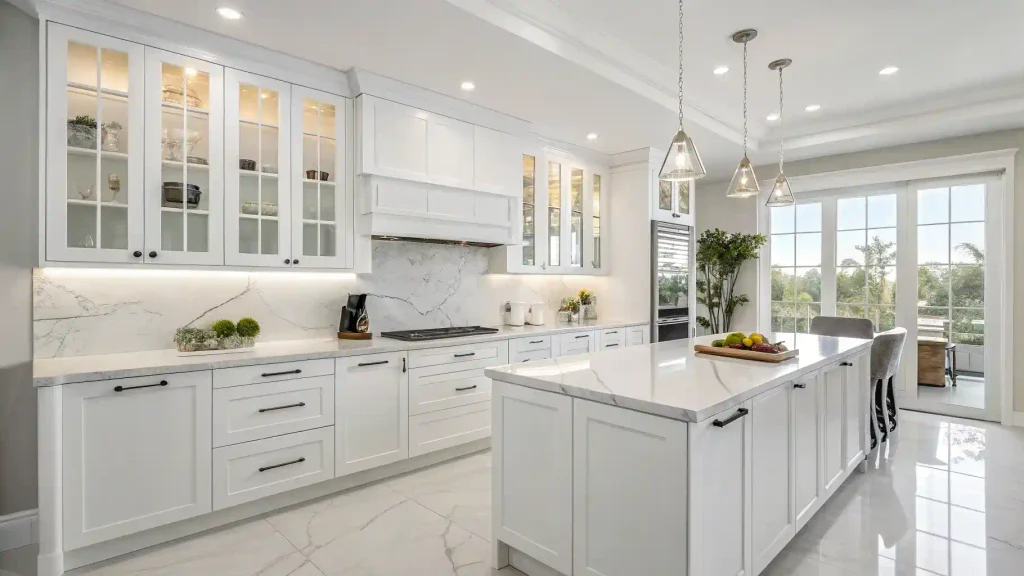
Cost to Install Granite Countertops
The cost to install granite countertops depends on more than the slab price. A complete installed project usually includes the granite material, templating, fabrication, standard edge finishing, delivery, seam work, installation, and final fitting. Some fabricators include these items in one price, while others separate them, so we recommend comparing quotes based on the full scope rather than looking only at the advertised material price.
Additional costs can come from upgraded edge profiles, undermount sink cutouts, cooktop openings, faucet holes, full-height backsplash, waterfall panels, difficult site access, cabinet corrections, demolition, and removal of existing countertops. For many residential projects, an installed planning range of approximately $45 to $120 per square foot is a useful starting point, but premium granite and complex fabrication can move the final price higher.
Granite Templating Cost
Templating is the measurement process used to capture the exact countertop dimensions after the base cabinets are installed, secured, and properly leveled. It is especially important in older homes, L-shaped kitchens, U-shaped layouts, islands, and spaces where walls are not perfectly straight. Templating may be included in the overall countertop price or charged separately, depending on the fabricator.
We recommend finalizing the sink, cooktop, and major countertop details before the template is created. Changes after templating can affect fabrication and may require new measurements, revised cutouts, or additional material.
Granite Fabrication Cost
Fabrication is the process of turning a raw granite slab into finished countertop pieces. It includes cutting the slab to size, preparing seams, shaping exposed edges, polishing cut surfaces, and creating openings for sinks, cooktops, faucets, and other fixtures. The more complicated the layout, the more fabrication time the project usually requires.
A simple straight countertop with one sink cutout and an eased edge is easier to fabricate than a U-shaped kitchen with several seams, decorative edges, directional veining, and waterfall panels. Because of this, two kitchens with similar square footage can still have very different finished prices.
Granite Delivery and Installation Cost
Granite is heavy, and large countertop pieces require careful transportation and handling. Delivery and installation may be included in the overall price or listed separately. Oversized islands, stairs, elevators, narrow doorways, tight hallways, and difficult exterior access can increase the amount of labor needed to move and install the stone safely.
During installation, the fabricators position each countertop section, complete seams, verify fit, make final adjustments, and secure the stone to the prepared cabinets. Large or complicated pieces may require additional installers or specialized handling equipment.
Old Countertop Removal Cost
If the existing countertops need to be removed, demolition and disposal should be included in the project budget. For early planning, removal may add roughly $7 to $15 per square foot, although the actual amount depends on the material being removed, how it was installed, site access, and disposal requirements.
Laminate is generally easier to remove than stone or tile, while heavily adhered materials may require more labor. If the existing cabinets will remain, careful removal is important so the cabinet boxes are not damaged before the new granite is installed.
What Is the Average Price for Granite Countertops Installed?
For practical budgeting, many installed granite countertop projects fall around $45 to $120 per square foot. This range is more useful than one national average because granite pricing varies based on slab rarity, color, movement, thickness, finish, edge profile, cutouts, seams, backsplash, and installation complexity.
A moderate kitchen may cost a few thousand dollars, while a large kitchen using premium or exotic granite can cost significantly more. At Columbus Cabinets City, we prefer to base pricing on the actual kitchen layout, countertop square footage, slab selection, fabrication details, and installation requirements rather than treating one average number as accurate for every project.
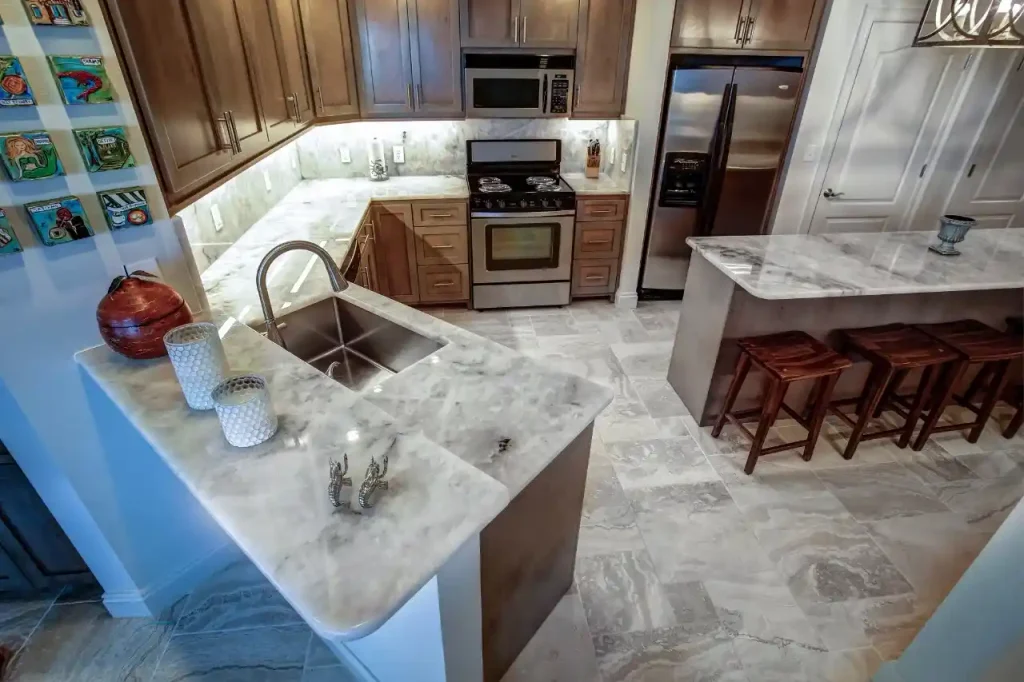
What Affects Granite Countertop Cost?
Granite countertop cost is influenced by a combination of material characteristics and fabrication requirements. Square footage matters, but it is only one part of the final price. Natural stone varies in rarity, color, quarry location, movement, slab dimensions, and availability, while the kitchen design adds variables such as corners, seams, edges, cutouts, backsplashes, and island details.
When we review granite options with homeowners, we recommend evaluating the complete project rather than focusing only on the slab price. Two 50-square-foot kitchens can cost very different amounts when one uses a common polished granite with a standard edge and the other uses a rare leathered stone with dramatic movement, multiple seams, and a waterfall island.
Granite Color
Granite color can influence cost because some colors are widely available while others come from limited quarry sources. Common black, gray, beige, brown, and selected white stones may be available at moderate prices, while rare blue, green, red, or highly unusual multicolor granites often cost more because they are harder to source.
The color itself is not the only factor. Two white granites can have completely different prices depending on quarry production, mineral movement, demand, and availability. We recommend comparing specific slabs rather than assuming that every granite within the same color family will fall into the same pricing level. If you are still deciding on a direction, our guide on how to choose the right kitchen countertop color can help narrow the options first.
Granite Rarity
Rarity is one of the biggest reasons one granite slab can cost substantially more than another. A stone produced from an active quarry with reliable supply is easier to source and generally more affordable than a material available only from a small quarry or limited region.
Rare granite does not automatically perform better than a common granite. In many cases, the higher price reflects its visual uniqueness and limited availability. Homeowners who want an unusual focal-point countertop may find the premium worthwhile, while others can achieve a beautiful kitchen with a more widely available material.
Granite Origin
Granite is quarried in many parts of the world, and transportation, importation, distribution, and quarry conditions can influence the final material price. A stone traveling a long distance through several distribution channels may carry higher freight and handling costs than a material that is widely stocked closer to the project.
Origin should not be considered by itself when judging price. Some imported granites are extremely common and affordable, while others are rare and expensive. The actual slab, availability, and supplier matter more than simply whether the granite was imported.
Granite Veining
Granite with dramatic veining or sweeping natural movement can cost more when the pattern is visually distinctive or comes from a less-common stone. Strong veins may also affect fabrication because the countertop pieces need to be positioned thoughtfully so the finished surface looks balanced.
Vein alignment becomes especially important on large islands, waterfall ends, full-height backsplashes, and seams. If we want the movement to continue naturally across multiple pieces, the fabricator may need to use more of the slab or reserve specific sections, increasing material waste and potentially the number of slabs required.
Pattern and Movement
Granite patterns range from fine speckling and relatively uniform mineral distribution to large flowing waves and dramatic directional formations. Uniform granite is generally easier to fabricate efficiently because countertop pieces can often be positioned without worrying about the direction of the pattern.
Strong directional movement requires more careful planning. Pieces cannot always be rotated freely without making the finished layout look disconnected. This can increase slab waste and fabrication time, particularly in L-shaped kitchens, U-shaped layouts, large islands, and projects where the homeowner wants the movement to flow continuously across seams or vertical surfaces.
Granite Slab Size
Slab size affects cost indirectly because larger slabs can sometimes reduce the number of seams needed in a kitchen. A large island that can be fabricated from one slab section usually looks cleaner than an island that requires a visible seam through the center.
However, oversized pieces are heavier and may require additional handling during transportation and installation. Large slabs can also belong to specific material categories or suppliers. The best approach is to compare slab dimensions with the actual kitchen layout rather than assuming that a bigger slab will automatically reduce or increase the final cost.
Does Granite Veining Increase the Cost?
Granite veining can increase cost when the selected stone belongs to a premium category or when the pattern requires additional planning during fabrication. Large directional veins often need to be positioned intentionally so the finished countertops look balanced, especially where multiple pieces meet. This can reduce how efficiently the slab can be used and create more offcuts.
The effect becomes more noticeable with waterfall islands and full-height backsplashes. If we want a vein to continue naturally from the horizontal countertop onto a vertical panel, the fabricator may need to reserve adjacent slab sections for those pieces. That visual continuity can look impressive, but it can also increase material usage and labor.
Does Granite Color Affect Price?
Granite color can affect price, but the relationship usually comes down to rarity and availability rather than color alone. Commonly quarried black, gray, beige, brown, and selected white granites may be available at more moderate prices, while rare blue, green, red, and unusual multicolored stones can command much higher prices.
At Columbus Cabinets City, we recommend comparing individual granite selections instead of making assumptions based on color categories. A common black granite may be very affordable, while another black stone with unusual mineral movement may be premium. The same variation applies to white, gray, and other popular granite families.
How Pattern and Movement Affect Granite Countertop Cost
Granite with a relatively uniform pattern is typically easier for a fabricator to lay out because sections can be positioned efficiently without creating an obvious change in direction. This can help reduce slab waste and simplify seam placement, especially in kitchens with several countertop runs.
Granite with large sweeping movement requires more careful planning. The fabricator may need to choose specific portions of the slab for the island, perimeter, backsplash, or corners so the pattern looks intentional. That planning can reduce material efficiency, particularly when the project includes L-shaped counters, U-shaped kitchens, large islands, or waterfall edges.
Granite Countertop Thickness Cost
Granite countertops are commonly available in approximately 2 cm and 3 cm thicknesses, although specific availability depends on the stone and supplier. A 3 cm slab uses more material and creates a thicker visible profile, while a 2 cm slab can provide a lighter appearance and may cost less at the material level.
Thickness should not be selected based only on price. Support requirements, cabinet construction, edge design, overhangs, slab availability, and the overall appearance of the kitchen all matter. A thinner slab may require additional support or built-up edge fabrication, which can reduce some of the initial material savings. Reviewing current kitchen countertop thickness trends can also help you decide which profile suits the style of your kitchen.
2 cm Granite Countertops
A 2 cm granite slab is roughly three-quarters of an inch thick and creates a thinner countertop profile. The material may cost less than an equivalent 3 cm slab, but additional plywood support, edge build-up, or other installation details may be necessary depending on the project.
Because of those additional requirements, the finished installed cost difference may be smaller than the raw slab price suggests. We recommend evaluating 2 cm granite as part of the complete countertop design rather than choosing it only because the slab appears less expensive.
3 cm Granite Countertops
A 3 cm granite slab is roughly one and one-quarter inches thick and is widely used for kitchen countertops and islands. It creates a more substantial visible edge and generally provides more flexibility for edge profiles without requiring a laminated build-up.
Although the material can cost more than a thinner slab, 3 cm granite is often a straightforward choice for residential kitchens because the thicker profile works well with many cabinet styles. The final decision should still account for stone availability, overhangs, edge design, and structural requirements.
Laminated Thick-Look Granite Edges
A laminated granite edge uses an additional strip of stone to make the countertop appear thicker than the actual slab. This can create a more substantial or furniture-like appearance, especially on islands, traditional kitchens, or projects where a heavy visual profile is part of the design.
The additional stone must be cut, bonded, aligned, shaped, and polished carefully so the seam is visually controlled. Because this process requires extra material and fabrication labor, a laminated edge usually costs more than leaving the standard slab thickness visible.
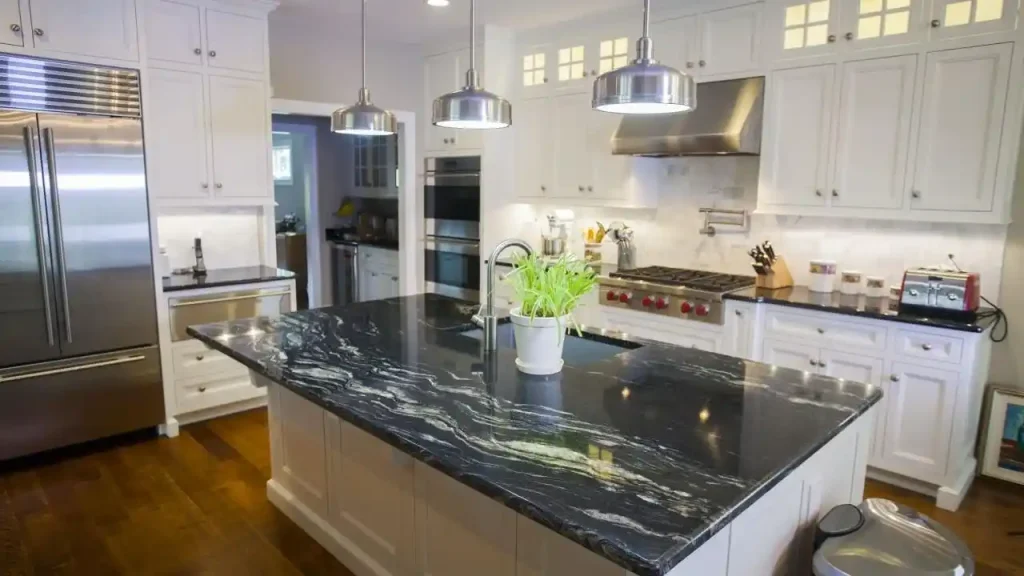
How Granite Finish Affects Cost
Granite can be finished in several ways, and each finish changes both the appearance and the cost of the countertop. Polished granite is the most common and usually serves as the standard baseline, while honed, leathered, antiqued, and other specialty finishes may require additional processing or may only be available through certain suppliers.
The finish also changes how the stone’s color, mineral structure, and veining are perceived. A polished black granite can appear deep and reflective, while the same general color in a honed or leathered finish may look softer and more textured. We recommend choosing a finish based on both appearance and maintenance expectations rather than cost alone.
Polished Granite
Polished granite has a smooth, reflective surface that brings out the stone’s natural color, mineral deposits, and veining. It is one of the most widely available granite finishes and is commonly treated as the standard option for kitchen countertops. Because polishing is typically part of normal slab production, it usually serves as the baseline price when comparing specialty finishes such as honed or leathered granite.
The polished finish can make darker colors appear deeper and can emphasize the contrast between different minerals in the stone. It works well in traditional, transitional, and contemporary kitchens and is especially useful when the homeowner wants the natural granite pattern to remain highly visible.
Honed Granite
Honed granite has a smooth matte or low-sheen surface rather than the reflective appearance of polished stone. The softer finish can reduce glare, mute strong colors, and create a more understated look that works especially well in contemporary, farmhouse, and transitional kitchens.
Honed granite may cost more when the selected stone is normally supplied polished and requires additional finishing before fabrication and installation. Dark honed surfaces can also show oils, fingerprints, or temporary marks differently from polished stone, so we recommend considering both appearance and everyday maintenance before selecting this finish.
Leathered Granite
Leathered granite has a textured, low-sheen surface that emphasizes the natural character of the stone without producing the strong reflection associated with polished granite. The finish can make darker stones feel richer and may highlight mineral variations, pits, and movement within the slab in a more tactile way.
Because leathering involves additional surface processing and is not available as a standard finish on every granite, it can carry a higher price depending on the stone and supplier. It works particularly well on islands and darker granite selections where texture is intended to become part of the overall kitchen design.
Antiqued or Textured Granite
Antiqued and other textured granite finishes create a more tactile surface that emphasizes the natural structure of the stone. These finishes are less common than polished granite and may require additional processing, which can increase the material or fabrication cost.
They can work particularly well in rustic, traditional, Mediterranean, or highly customized kitchens where a smooth polished surface would feel too formal. Because texture can influence cleaning and everyday maintenance, we recommend viewing a full sample and understanding the care requirements before selecting a specialty finish.
Granite Countertop Edge Cost
The countertop edge affects granite cost because each profile requires a different amount of cutting, shaping, and polishing. A simple eased edge is commonly included in standard fabrication, while bevel, bullnose, ogee, mitered, and other decorative profiles generally add cost based on the number of exposed linear feet. You can see how each profile looks in our guide to countertop edge designs.
Islands can have a greater edge cost than perimeter counters because several sides may be exposed and finished. For early planning, upgraded granite edges may add approximately $5 to $40 or more per linear foot, depending on the profile, stone thickness, fabricator, and amount of work required.
Eased Edge Cost
An eased edge has a clean, nearly square appearance with the sharp corners slightly softened for comfort and durability. It is one of the most common granite countertop edges because it works with modern, transitional, and traditional cabinet styles without drawing attention away from the stone.
An eased edge is also frequently included in standard fabrication pricing, which makes it a practical option when we are trying to control countertop cost. Homeowners can invest more in the granite itself while keeping fabrication relatively simple and still achieve a clean, professionally finished appearance.
Beveled Edge Cost
A beveled edge introduces an angled cut along the upper portion of the countertop and creates more visible detail than a standard eased profile. It can work particularly well in transitional kitchens where homeowners want a slightly decorative edge without choosing a highly traditional profile.
Because the bevel requires additional machining and polishing, it may carry an upgrade charge. The total cost depends on the number of exposed linear feet, the depth of the bevel, the fabricator’s pricing structure, and the thickness of the granite slab being used.
Bullnose Edge Cost
A bullnose edge creates a rounded countertop profile and may be fabricated as a full bullnose or a half-bullnose depending on the desired appearance. Rounded edges can soften the visual weight of a thick granite countertop and work especially well with traditional, transitional, and family-oriented kitchen designs.
A bullnose requires more shaping and polishing than a standard eased edge, so it is commonly priced as an upgrade. Islands may have a higher total bullnose cost because several sides of the countertop can be exposed and require finished edge fabrication.
Ogee Edge Cost
An ogee edge uses a decorative curved profile that creates a more traditional and detailed countertop appearance. It is often paired with raised-panel cabinetry, ornate kitchens, furniture-style islands, and other designs where the countertop edge is intended to become a visible decorative element.
Because an ogee requires more machining and polishing than simpler profiles, it is generally one of the more expensive edge upgrades. We recommend using it when the edge supports the overall kitchen style rather than selecting it simply because it is more elaborate.
Mitered Edge Cost
A mitered edge is used to create the appearance of a thicker granite countertop by joining additional stone at a carefully cut angle. The technique can make an island or perimeter countertop appear much more substantial without requiring an unusually thick solid slab.
This edge generally costs more because the fabricator needs additional material, precision cutting, alignment, bonding, and finishing. Mitered edges can be especially effective on large islands where the thicker visual profile becomes an important part of the kitchen design.
Granite Waterfall Countertop Cost
A granite waterfall countertop extends the stone vertically down one or both sides of an island rather than ending at the horizontal surface. The look can be dramatic, but it increases cost because the project requires additional granite, precise miter fabrication, careful handling, and extra installation time.
For planning purposes, a granite waterfall can add roughly $500 to $2,000 or more per side, depending on the island dimensions, granite selection, veining, slab requirements, and complexity. Highly directional granite may cost more because the fabricator needs additional material to create a visually connected pattern from the countertop to the vertical panel.
One-Sided Granite Waterfall
A one-sided waterfall uses granite on only one exposed side of the island and can create much of the visual impact of a full waterfall design while requiring less stone. This approach works especially well when one island end faces the main living space and the opposite end is less visible.
Using a waterfall on only the most visible side can also help control the countertop budget. The exact increase depends on panel dimensions, edge fabrication, stone pattern, slab utilization, and whether the design requires precise vein matching between the horizontal and vertical surfaces.
Two-Sided Granite Waterfall
A two-sided waterfall extends granite down both exposed island ends and creates a more dramatic furniture-like appearance. This design can make a large island the visual centerpiece of the kitchen, especially when the granite contains bold movement or unusual mineral patterns.
The feature requires two additional vertical stone panels along with precise miter fabrication, alignment, and installation. If the stone has strong directional veining, additional slab material may be required to create a natural transition across both ends, which can push the project cost substantially higher.
Granite Kitchen Island Cost
Kitchen islands can represent a large portion of the granite countertop budget because they often contain a substantial amount of stone in one visible surface. Islands may also require several finished edges, seating overhang support, sink or cooktop cutouts, oversized slab handling, and additional installers during placement. The size and layout of your kitchen island cabinets set the stone dimensions, so the two should be planned together.
The dimensions of the island matter much more than the word “island” itself. A 3-by-5-foot island contains only 15 square feet of horizontal granite, while a 4-by-10-foot island contains 40 square feet before waterfall panels, backsplash details, or other vertical stone features are added.
| Island Size | Approx. Surface Area | Planning Range at 45–120/sq. ft. |
| 3′ × 5′ | 15 sq. ft. | 675–1,800 |
| 3′ × 7′ | 21 sq. ft. | 945–2,520 |
| 4′ × 6′ | 24 sq. ft. | 1,080–2,880 |
| 4′ × 8′ | 32 sq. ft. | 1,440–3,840 |
| 4′ × 10′ | 40 sq. ft. | 1,800–4,800 |
These figures cover the horizontal surface only. Waterfall ends, decorative edges, overhang supports, sink cutouts, cooktop openings, rare granite, difficult delivery conditions, or large slab requirements can increase the total island cost significantly.
Straight Kitchen Granite Countertop Cost
A straight countertop run is generally one of the simplest granite layouts to fabricate because there are fewer corners, fewer pattern-direction changes, and fewer opportunities for complex seams. This can allow the fabricator to use slab material efficiently and keep labor relatively straightforward compared with more complicated kitchen configurations.
The final price still depends on countertop length, granite selection, edge profile, cutouts, backsplash requirements, and whether the run exceeds the available slab length. A long straight counter may still need a seam, especially when appliances or sink openings affect where pieces can safely be fabricated and installed.
L-Shaped Granite Countertop Cost
An L-shaped kitchen introduces an inside corner, which makes templating, fabrication, and seam placement more complicated than a straight countertop. The fabricator needs to determine how the two runs will meet and how the natural granite pattern should transition through the corner.
Directional granite can create additional waste because adjoining pieces may need to be cut from specific areas of the slab to maintain visual continuity. A simpler speckled granite is usually easier to position. The cost therefore depends on both total square footage and the pattern characteristics of the actual stone selected.
Example L-Shaped Granite Countertop
Consider an L-shaped kitchen with one 10-foot countertop run and one 8-foot run at approximately standard countertop depth. The rough surface area is around 38 square feet before accounting for the corner overlap, appliance openings, and other adjustments.
Using the general $45 to $120 per square foot installed planning range, the granite portion could roughly fall between $1,700 and $4,600. Premium stone, multiple cutouts, upgraded edges, complex seam planning, backsplash, and old countertop removal could increase the finished project cost beyond that range.
U-Shaped Granite Countertop Cost
A U-shaped kitchen usually requires more granite and more fabrication planning than a straight or L-shaped layout because it includes three connected countertop runs and two inside corners. Depending on slab size and room dimensions, the project may also require multiple seams.
Granite with large directional movement makes the fabrication plan even more important. We want each countertop section to feel connected rather than randomly cut, which can require specific slab placement and additional material. This is one reason U-shaped kitchens can cost more than their square footage alone might suggest.
Example U-Shaped Granite Countertop
Imagine a U-shaped kitchen with a 10-foot back run and two 8-foot side runs. At approximately standard countertop depth, the rough surface area is around 55 square feet before accounting for corner overlaps, ranges, sinks, or other openings.
Using the $45 to $120 per square foot planning range, the granite portion could roughly fall between $2,475 and $6,600. Premium stone, multiple seams, decorative edges, cutouts, full-height backsplash, or difficult installation conditions can push the total substantially higher.
Galley Kitchen Granite Countertop Cost
A galley kitchen typically uses two opposing straight countertop runs, which can make fabrication relatively efficient because there are fewer inside corners than an L-shaped or U-shaped kitchen. However, the total granite square footage can still be significant when both walls contain long countertop sections.
Galley layouts can work especially well with directional granite because each run can often be planned independently. The final price depends on the length of both runs, sink and cooktop cutouts, edge profiles, slab selection, backsplash, and whether either countertop section exceeds the usable slab dimensions and requires a seam.
Granite Backsplash Cost
Granite can be used as a traditional short backsplash or extended vertically into a full-height slab backsplash. A short backsplash uses relatively little additional material and can sometimes be fabricated efficiently from remaining slab sections. A full-height backsplash adds much more granite and can become a major part of the project budget. Some homeowners keep a short granite splash and finish the wall with kitchen backsplash tile to control the overall cost.
Using the same granite on both the countertop and backsplash can create a continuous, high-end appearance, especially when the slab has attractive movement. However, matching strong veins or mineral patterns may require additional material and careful fabrication, which can increase both stone usage and installation cost.
4-Inch Granite Backsplash
A short granite backsplash typically uses narrow strips of the same material along the wall behind the countertop. Because the pieces are relatively small, they may sometimes be fabricated from portions of the slab that would otherwise have limited use.
This makes a 4-inch backsplash more budget-friendly than a full-height slab installation. The exact price depends on the total linear footage, granite selection, edge finishing, and whether the backsplash pieces can be cut efficiently from the material already required for the countertops.
Full-Height Granite Backsplash
A full-height granite backsplash extends from the countertop to the upper cabinets or ceiling and can make the stone a major design feature. The approach works especially well with granite that has attractive veining or dramatic mineral movement.
The additional wall coverage can add substantial square footage to the project. Pattern matching also becomes important, particularly when homeowners want veins to flow naturally from the countertop onto the wall. That may require additional slabs or careful material selection and can significantly increase the total countertop budget.
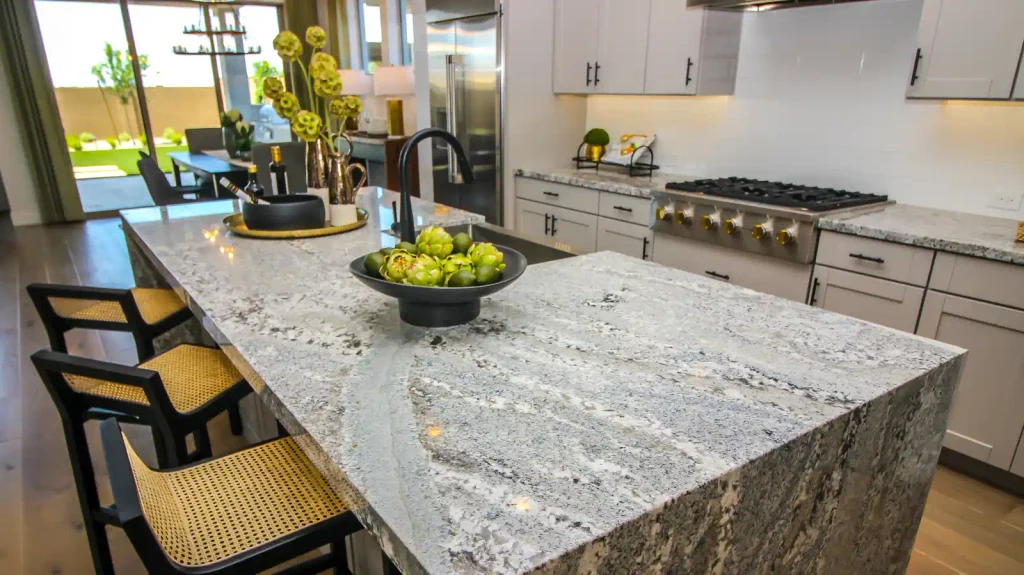
Granite Sink Cutout Cost
An undermount sink cutout requires precise fabrication because the opening must be cut to the sink dimensions and the exposed interior granite edge must be carefully polished. For early budgeting, a granite sink cutout may add roughly $100 to $300, although actual pricing depends on sink size, shape, stone, and fabrication details.
Farmhouse and apron-front sinks can require even more coordination because the sink affects both the countertop and the cabinet below it. We recommend finalizing the exact sink model before countertop templating so the fabricator can work from accurate dimensions rather than estimates.
Granite Cooktop Cutout Cost
A cooktop opening requires the granite to be fabricated according to the exact appliance dimensions and clearance requirements. For planning, cooktop cutouts may add roughly $120 to $400, depending on size, shape, stone, and fabricator pricing.
The appliance model should be finalized before granite fabrication begins. Changing the cooktop after the countertop has already been cut can create major complications because the opening may no longer fit correctly. We recommend providing the fabricator with the manufacturer’s exact installation specifications during the templating and planning stage.
Faucet and Accessory Hole Costs
Faucets, soap dispensers, filtered-water faucets, air switches, and other countertop-mounted accessories require holes to be drilled through the granite. These may already be included in a fabrication package or charged individually depending on the countertop company and number of openings.
For general planning, individual holes may add roughly $20 to $60 each where they are not already included. We recommend deciding on all deck-mounted fixtures before fabrication so the granite arrives with the correct number, size, and placement of holes rather than requiring unnecessary field modifications after installation.
How Seams Affect Granite Countertop Cost
Granite seams may be required when a countertop run exceeds slab dimensions, when the kitchen contains inside corners, or when an oversized piece cannot be transported safely into the home. Each seam requires additional fabrication, alignment, adhesive, leveling, and finishing during installation.
Pattern also influences seam difficulty. A relatively uniform granite can be easier to join visually than a slab with large directional veins. When movement needs to line up naturally, the fabricator may need to reserve particular slab sections for adjoining pieces, which can increase waste and sometimes require additional material.
How Much Does Granite Countertop Removal Cost?
Removing existing countertops adds another expense when demolition is not already included in the granite installation package. For early budgeting, countertop removal and disposal may cost roughly $7 to $15 per square foot, although the material being removed can change the labor requirement significantly.
Laminate is usually easier to remove than thick natural stone or tile that has been installed over mortar and backer materials. If the existing cabinets will remain, careful demolition is especially important because damage to the cabinet boxes can create additional repairs before the new granite can be templated or installed.
Cabinet Leveling and Granite Countertop Cost
Granite countertops need a properly prepared foundation, which means the kitchen base cabinets should be secure, level, and correctly aligned before final measurements are taken. Long granite runs and large islands can make small cabinet-level differences more noticeable, and the stone should not be used to compensate for poorly installed cabinetry.
At Columbus Cabinets City, we recommend resolving cabinet alignment before countertop templating. If cabinets require shimming, fastening, adjustment, or structural corrections, completing that work first gives the fabricator a stable reference and helps reduce fitting problems during granite installation. If you are handling the cabinetry yourself, our guide on how to install kitchen cabinets covers leveling and fastening in detail.
How Many Granite Slabs Will I Need?
The number of granite slabs required for a kitchen depends on more than total countertop square footage. Slab dimensions, countertop lengths, island size, pattern direction, cutouts, seams, natural fissures, and the way individual pieces fit onto the stone all influence material usage.
Dividing total countertop square footage by slab square footage can therefore underestimate how much granite is actually needed. Large islands, U-shaped layouts, directional movement, waterfall panels, and full-height backsplashes can all require additional material. A fabrication layout is the most reliable way to determine how efficiently a particular slab can be used.
Do Natural Fissures and Slab Quality Affect Granite Cost?
Granite is a natural material, so color variation, mineral lines, pits, movement, and natural fissures can appear within a slab. These characteristics are not automatically defects and often contribute to the unique appearance that homeowners want from natural stone.
However, slab condition and visual quality can affect how the material is priced and fabricated. Premium slabs may be selected because they contain especially attractive movement or fewer areas that need to be avoided during cutting. In other cases, a rare mineral pattern or unusual combination of colors may make the stone more valuable even when its basic performance is similar to less-expensive granite.
Can Granite Remnants Reduce the Cost?
Granite remnants can be a cost-effective option for smaller surfaces such as bathroom vanities, laundry countertops, bar tops, desks, shower thresholds, fireplace surrounds, or small cabinet runs. A remnant is a usable piece left over from a previously fabricated slab, which means the customer may not need to allocate or purchase an entire new slab.
For a full kitchen, remnants are usually less practical because matching color, pattern, thickness, and finish across multiple pieces can be difficult. We generally recommend considering remnants for secondary spaces rather than relying on them to complete a large connected kitchen countertop layout.
Is Granite More Expensive Than Quartz?
Granite and quartz pricing overlap considerably, which means neither material is automatically more expensive in every project. A common entry-level granite can cost less than premium marble-look quartz, while a rare exotic granite may cost substantially more than many engineered quartz designs. For a full breakdown of engineered stone pricing, see our quartz countertops cost guide.
When homeowners compare granite and quartz with us, we recommend evaluating specific selections rather than broad material categories. Compare installed cost, appearance, pattern consistency, maintenance expectations, finish options, slab availability, and how each surface coordinates with the cabinetry. The actual products being considered provide a much more useful comparison than a general statement about which material is cheaper. Our side-by-side comparison of granite vs quartz vs marble cost shows how the three materials line up.
How to Save Money on Granite Countertops
Reducing granite countertop cost does not require choosing the cheapest stone available. In many projects, a better strategy is to invest in a granite slab you genuinely like and simplify fabrication details that have less impact on the overall design. Standard edges, efficient layouts, widely available stones, and limited slab backsplash coverage can all help control the budget.
We also recommend evaluating the kitchen as a complete design. A beautiful granite countertop with a simple eased edge can create more impact than an average stone with several expensive fabrication upgrades. Decide which features matter most to you and direct the budget toward those areas first.
Choose a More Common Granite
Widely available granite usually costs less than rare or exotic stone because quarry supply and distribution are more consistent. Common black, gray, brown, beige, and selected white granite options can provide a high-quality natural-stone appearance without paying the premium associated with limited materials.
The lower price does not necessarily indicate lower durability. In many cases, the difference comes primarily from supply and demand. We recommend viewing several slabs within the same general color family before deciding that a rare option is necessary to achieve the look you want.
Choose a Standard Edge
A standard eased edge is one of the easiest ways to keep fabrication cost under control. The profile works with nearly every cabinet style and allows the natural granite pattern to remain the main visual feature rather than drawing attention to the countertop edge.
Decorative profiles can be beautiful, but they add machining and polishing costs across every exposed linear foot. If budget is a priority, keeping the edge simple often provides meaningful savings without making the countertop look unfinished or inexpensive.
Avoid Unnecessary Waterfall Panels
Waterfall islands can create a dramatic focal point, but they require additional stone, miter fabrication, installation labor, and sometimes extra slab material for pattern matching. If the island already has attractive finished cabinet panels, adding granite vertically may not be necessary.
Homeowners who like the waterfall look but want to control the budget can consider using it on only one highly visible island end. This preserves much of the visual effect while reducing the amount of granite and fabrication compared with a two-sided waterfall.
Keep the Layout Efficient
Straight countertop runs generally use granite more efficiently than complex shapes with several corners, angles, and small disconnected sections. A simpler layout can reduce fabrication time, seams, and slab waste, particularly when the selected granite contains directional movement.
This does not mean changing a functional kitchen only to save countertop cost. However, when cabinets and countertops are being designed together, considering slab efficiency early can help prevent unnecessary waste and make it easier to create clean seam locations.
Compare Similar Granite Slabs
If you like a specific white, black, gray, or beige granite, compare several stones with similar overall coloring and movement before finalizing the selection. A widely available granite may create a very similar finished look at a lower price than a rare imported stone.
Because granite is natural, we recommend looking at full slabs rather than relying entirely on small samples. Seeing the complete material helps you evaluate movement, color variation, mineral pattern, and how much usable stone is available for the countertop layout.
Limit Full-Height Granite Backsplash
A full-height granite backsplash can be beautiful, but it adds significant square footage and may require extra slabs or careful pattern matching. If controlling cost is important, consider using a traditional short granite backsplash or a separate tile backsplash instead.
Another option is to use full-height granite only in one focal area, such as behind the range, while using tile elsewhere. This approach can preserve the visual impact of slab backsplash without adding granite across every wall in the kitchen.
How to Get an Accurate Granite Countertop Estimate
The most accurate granite countertop estimate starts with a defined cabinet layout and an actual stone selection. Approximate measurements are useful during early budgeting, but final pricing should reflect the specific slab, countertop dimensions, cutouts, seams, edge profile, backsplash, island details, and site conditions.
At Columbus Cabinets City, we recommend finalizing the sink, faucet, cooktop, island dimensions, edge profile, backsplash approach, and granite selection before fabrication begins. The more decisions that are confirmed early, the fewer unknowns remain in the quote and the easier it becomes to understand the complete project budget. When you are ready, request a free design and quote and we will price your layout using the actual slab.
When requesting an estimate, it helps to have your kitchen or cabinet layout, approximate countertop measurements, preferred granite color or slab, sink model, cooktop specifications, desired edge profile, backsplash preference, island dimensions, waterfall requirements, and information about whether existing countertops need to be removed.
Plan Your Granite Countertop Budget
Granite countertops cost more than the raw slab alone. The final price is shaped by square footage, rarity, quarry origin, color, veining, pattern movement, finish, thickness, edge profile, cutouts, seams, backsplash, island design, countertop layout, old material removal, delivery, and installation conditions. Understanding these details early makes it much easier to compare countertop estimates accurately.
At Columbus Cabinets City, we help homeowners compare granite countertops alongside cabinetry, backsplash, flooring, and other kitchen finishes so the project can be planned as one complete design. Instead of selecting stone based only on a square-foot price, we recommend looking at the actual slab, fabrication requirements, kitchen layout, and final installed cost before making the decision. If you are budgeting the full remodel, our guide to kitchen cabinets cost covers the other major line item.
Frequently Asked Questions About Granite Countertops Cost
For early budgeting, many installed granite countertop projects fall around $45 to $120 per square foot. Entry-level and widely available granite usually falls closer to the lower end, while premium and exotic stones can cost substantially more. The final price is also affected by edge profiles, cutouts, seams, backsplash, installation complexity, removal, and kitchen layout.
We recommend treating the square-foot range as a starting point rather than a guaranteed price. Once the actual granite slab and countertop design are selected, the fabrication plan provides a much more accurate picture of the complete project cost.
Granite countertop installation cost depends on the size and weight of the pieces, number of seams, kitchen layout, site access, cutouts, and cabinet condition. Fabrication and installation are often combined into one countertop price, making it difficult to separate labor from the finished material cost.
For this reason, we recommend comparing complete installed estimates rather than looking only at an installation labor number. One quote may include templating, standard edge work, delivery, and installation, while another may list those services separately.
For planning, many residential granite projects fall in the broad range of approximately $45 to $120 per square foot installed. A moderate kitchen may therefore cost a few thousand dollars, while a large kitchen or one using rare granite can cost considerably more.
The average becomes less useful when a project includes premium materials, elaborate edges, several cutouts, waterfall panels, or full-height backsplash. At Columbus Cabinets City, we prefer to base the budget on the actual layout and slab rather than trying to fit every project into one national average.
Using a broad installed planning range of $45 to $120 per square foot, approximately 20 square feet of granite could cost around $900 to $2,400 before premium upgrades or unusual project conditions are included.
Small projects can sometimes cost more than simple square-foot multiplication suggests because fabricators may have minimum charges or the selected stone may require allocating a larger slab section. Edge upgrades, sink cutouts, removal, delivery, and backsplash work can also increase the final amount.
At approximately $45 to $120 per square foot installed, 30 square feet of granite could roughly fall between $1,350 and $3,600 for many standard projects. This provides a useful starting point for a smaller kitchen, bar, or compact countertop layout.
The actual total depends on the granite selected and the fabrication requirements. Premium stone, decorative edges, sink or cooktop openings, seams, old countertop removal, and backsplash details can increase the price beyond the basic square-foot calculation.
Using the same $45 to $120 per square foot planning range, 40 square feet of granite could roughly cost $1,800 to $4,800 installed for many standard residential projects.
A 40-square-foot kitchen using a common polished granite and simple edge may remain within that range, while one using exotic stone, a decorative edge, multiple cutouts, and a slab backsplash can cost much more. We recommend using the calculation only for early planning and obtaining a project-specific quote after the slab is selected.
Yes, granite color can influence cost because some stones are much more available than others. Common black, gray, brown, beige, and selected white granite may be more moderately priced, while rare blue, green, red, and unusual multicolored slabs can carry premium pricing.
The price difference is usually tied to quarry supply, rarity, transportation, and demand rather than color itself. Two slabs within the same color family can have very different prices, so comparing specific stone selections is more useful than assuming one entire color category is expensive or affordable.
Granite with dramatic veining can cost more when the stone itself is rare or when the pattern requires more careful fabrication. Large directional movement can make slab layout less efficient because countertop sections need to be positioned so the veins look balanced across corners and seams.
The cost impact becomes even greater when vein matching is required across a waterfall edge or full-height backsplash. Those features may require more slab material and create additional waste, which can increase the total project price even when the countertop square footage remains unchanged.
Yes, granite thickness can affect cost because thicker slabs contain more material and can have different fabrication and support requirements. A 3 cm slab usually costs more at the material level than a similar 2 cm slab, but the thinner option may require additional support or edge build-up.
For that reason, the installed price difference is not always as large as the raw slab price suggests. We recommend choosing thickness based on cabinet style, edge design, overhangs, structural needs, and overall appearance rather than selecting the thinner stone solely to reduce cost.
A standard eased granite edge is often included in basic fabrication, while decorative profiles such as bevel, bullnose, ogee, laminated, or mitered edges may be charged separately. For planning, upgraded edges may add roughly $5 to $40 or more per linear foot depending on complexity.
The total edge cost depends on how much of the countertop perimeter is exposed. A large island often has more finished edge than a perimeter countertop because several sides are visible, so decorative edge upgrades can add up quickly on island-heavy kitchen designs.