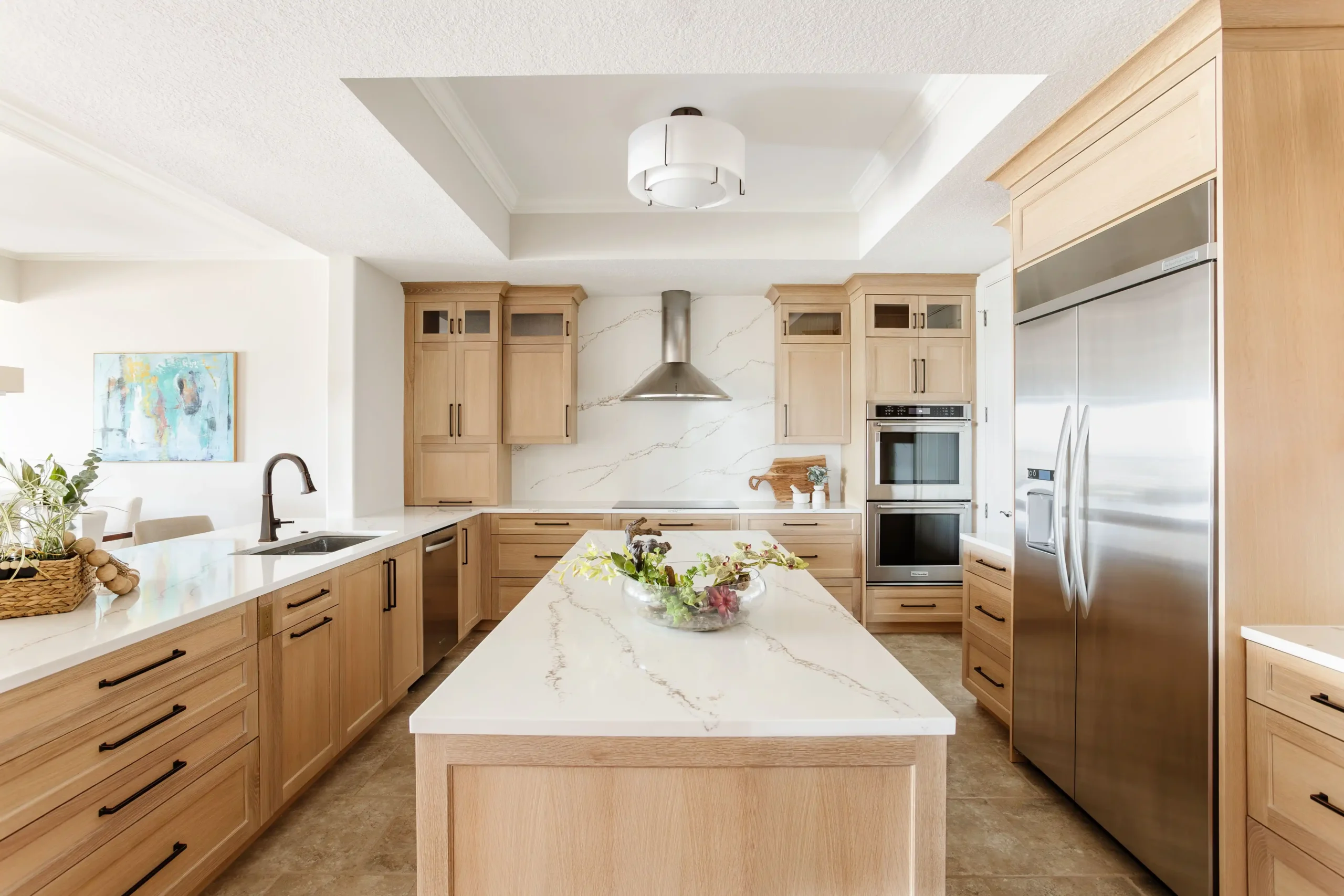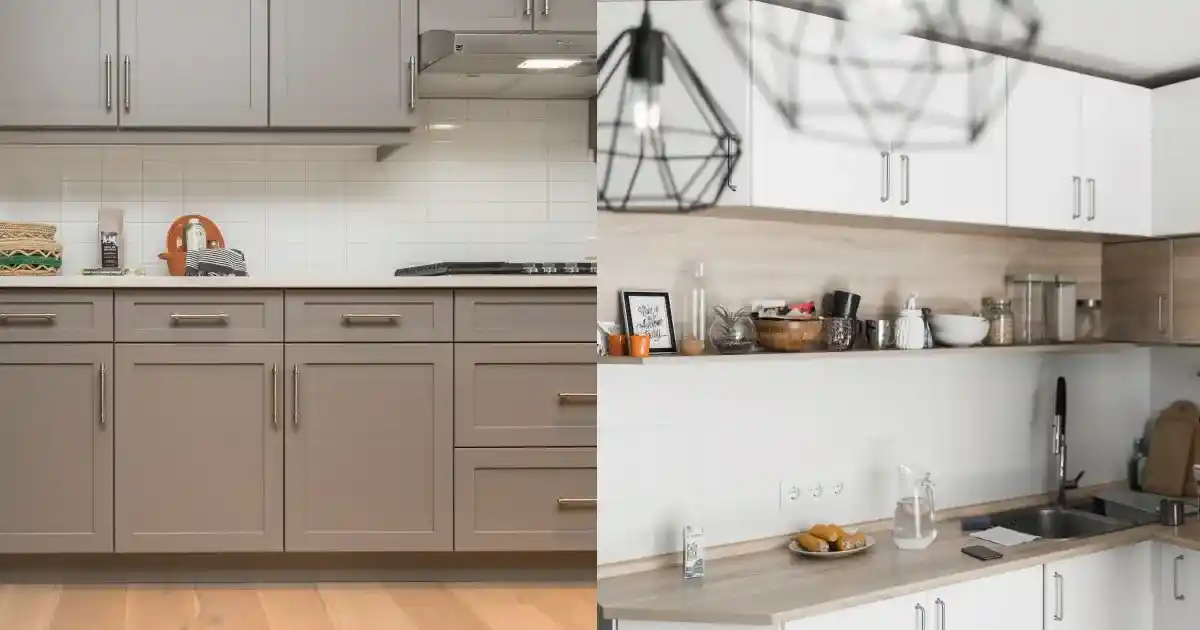
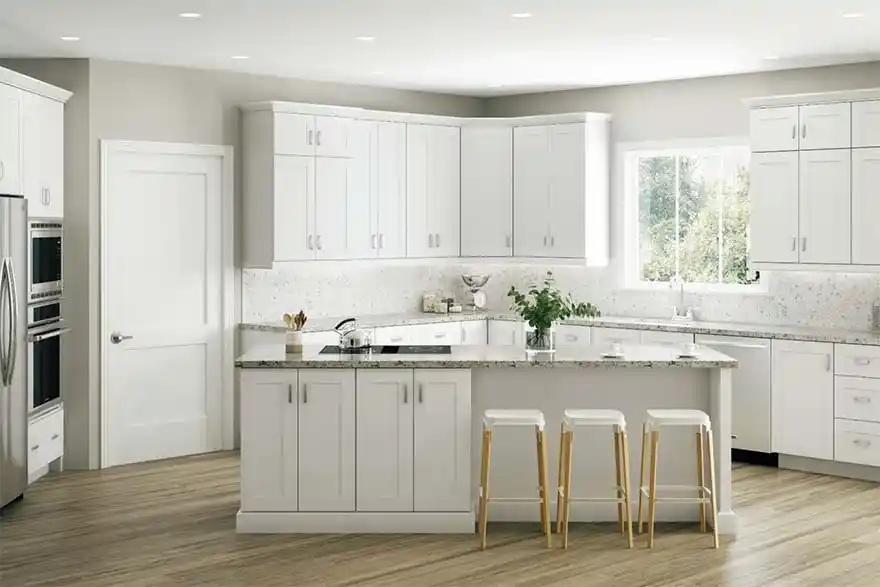
Shaker cabinets are kitchen cabinets with a clean recessed-panel door made from a simple outer frame and flat center panel. Their straightforward proportions give the door more depth than a completely flat cabinet while avoiding the carved details, arches, and raised molding associated with more decorative styles.
At Columbus Cabinets City, we consider Shaker cabinetry one of the most flexible starting points for kitchen design because the basic profile can change considerably depending on its proportions, material, color, overlay, hardware, and cabinet construction. A wide-frame inset Shaker door can look classic, while a narrow Shaker door on frameless cabinetry can feel noticeably more contemporary.
Understanding those differences is more useful than simply knowing what the word “Shaker” means. In this guide, we explain what Shaker cabinets are, what they are made of, how traditional and slim Shaker doors differ, what white Shaker cabinets actually offer, how construction affects their appearance, and what to compare before choosing them for your kitchen.
What Are Shaker Cabinets?
Shaker cabinets are defined by a door with a flat recessed center panel surrounded by a simple rectangular frame. A traditional five-piece door uses two vertical stiles, two horizontal rails, and one center panel. There is no raised center, carved ornament, arch, or decorative molding built into the basic profile.
The phrase Shaker style cabinets refers to this same door design rather than a separate type of cabinet. Shaker describes the door profile, not the cabinet’s color, wood species, price level, or box construction. That distinction is important because two Shaker kitchens can look similar from the front while using completely different materials and cabinet systems behind the doors.
Why Are They Called Shaker Cabinets?
The name comes from the Shaker communities known for furniture built around usefulness, straightforward construction, and limited decoration. Their approach favored balanced proportions and functional craftsmanship instead of adding ornament purely for appearance, which is reflected in the simple frame-and-panel design associated with Shaker cabinetry today.
Modern kitchen cabinets have evolved considerably from historical Shaker furniture, so we do not treat every modern Shaker product as a traditional reproduction. What remains relevant is the design principle: simple geometry, restrained detail, and a door profile that gets most of its character from proportion and material rather than decoration.
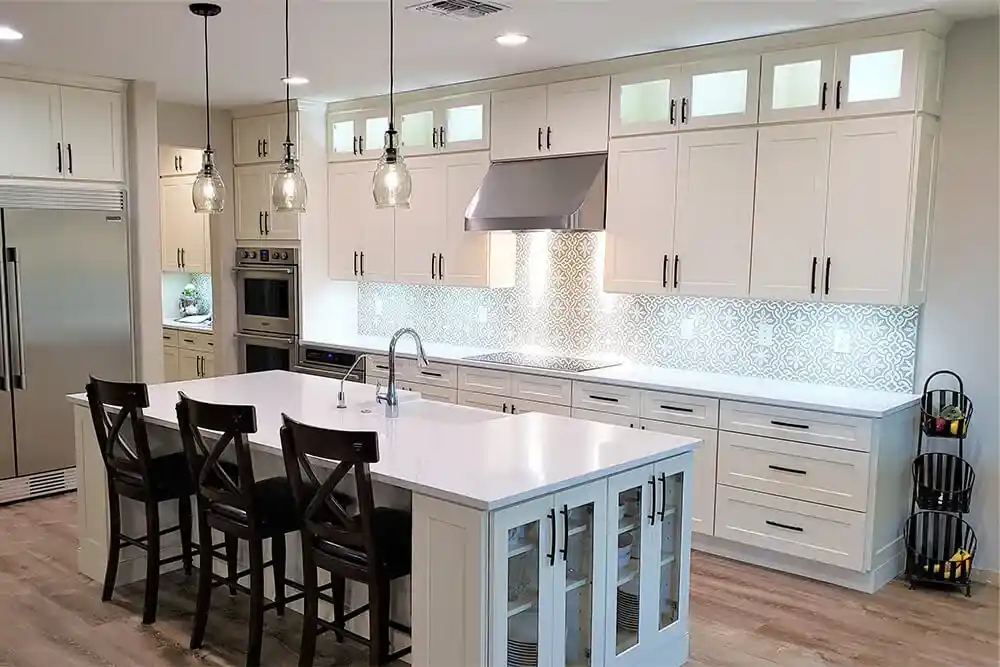
How Is a Shaker Cabinet Door Constructed?
Understanding the door construction makes it easier to recognize true Shaker styling and compare different cabinet lines. The basic design consists of a rectangular frame surrounding a recessed panel, but manufacturers can vary the width of that frame, the depth of the recess, the material, edge detail, joinery, and finishing method.
At Columbus Cabinets City, we recommend comparing full-size doors instead of relying only on a small color sample. A change in rail and stile width can make two cabinets with the same color and basic Shaker description look surprisingly different once they are installed across an entire kitchen.
Rails and Stiles
The two vertical portions of the outer frame are called stiles, while the top and bottom horizontal pieces are rails. Together, they establish the proportions of the cabinet door and create the border around the recessed center panel.
Their width plays a major role in the final appearance. Wider rails and stiles create a more substantial profile, while narrower versions reduce the amount of visible framing and make the door feel cleaner. This is one reason we pay attention to proportions rather than treating every Shaker door as visually identical.
Recessed Center Panel
The center panel sits behind the face of the surrounding frame, creating the recessed area that distinguishes Shaker cabinets from raised-panel doors. That small change in depth creates shadow and dimension without requiring ornamental carving or complicated molding.
The panel material can vary depending on how the cabinet is manufactured and finished. With stained cabinetry, manufacturers may use materials that preserve a natural wood appearance, while painted Shaker doors can use engineered materials chosen for a smoother and more stable finished surface.
Traditional Shaker vs Slim Shaker Cabinets
Traditional and slim Shaker cabinets share the same recessed-panel concept, but the proportions are different enough to change the personality of the kitchen. Traditional Shaker doors generally use wider rails and stiles, while slim Shaker doors reduce that surrounding frame to create a more understated appearance.
We recommend deciding between the two by looking at the overall kitchen rather than choosing whichever profile happens to be newer. Cabinet size, ceiling height, color, hardware, overlay, and the amount of cabinetry in the room all affect whether a wider or narrower frame looks more balanced.
Traditional Shaker Cabinets
Traditional Shaker doors use a more substantial outer frame, giving each cabinet front a clearly defined rectangular border. This works especially well when the kitchen needs some architectural detail but the homeowner does not want a raised-panel or heavily decorative cabinet style.
We often pair traditional Shaker proportions with transitional, farmhouse, or classic kitchens, although the profile itself does not require a traditional design. A simple countertop, contemporary hardware, and full-overlay installation can make even a wider Shaker frame feel noticeably more updated.
Slim Shaker Cabinets
Slim Shaker cabinets keep the recessed center panel but reduce the width of the surrounding frame. This creates less visual weight across the doors and drawers and brings the profile closer to the simplicity of a slab cabinet without eliminating the recessed detail entirely.
At Columbus Cabinets City, we see slim Shaker as a useful option for homeowners who like the structure of a panel door but want a cleaner overall appearance. It works particularly well with natural wood, muted painted finishes, minimal hardware, and full-overlay or frameless cabinet layouts.
What Are Shaker Cabinets Made Of?
Shaker cabinets can be made from solid wood, MDF, HDF, plywood, veneers, engineered panels, or combinations of several materials. The Shaker name does not tell you what the cabinet is made from because the term describes the door profile rather than the materials used in the door, cabinet box, shelves, drawers, and back.
When we compare cabinet quality at Columbus Cabinets City, we look at each component separately. The door material matters, but so do the cabinet box, drawer boxes, shelves, back construction, joinery, hinges, drawer slides, and finish. A cabinet should not be judged as high or low quality based only on whether one part contains solid wood.
Solid Wood Shaker Doors
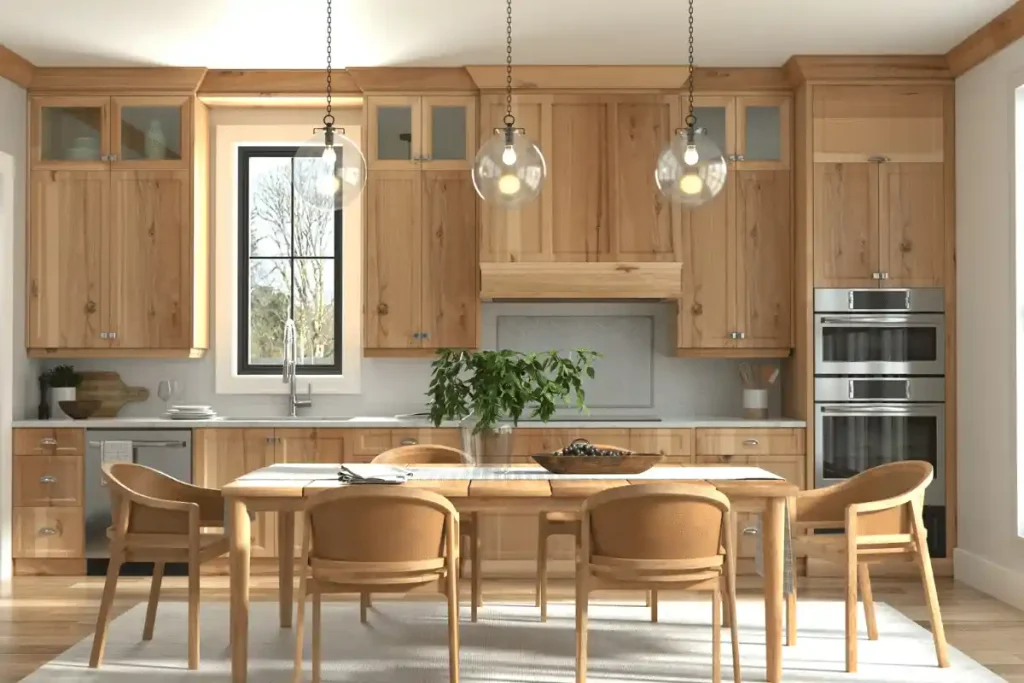
Solid hardwood is commonly used when homeowners want the natural grain to remain visible through stain or a clear finish. Maple, oak, cherry, hickory, and other species can give the same Shaker profile completely different character because the grain, color, and natural variation become part of the finished design.
Wood also responds naturally to changes in humidity, so quality manufacturing and finishing are important. With traditional frame-and-panel doors, the construction can allow for normal material movement while maintaining the overall shape of the door.
MDF and HDF Shaker Doors
MDF and HDF are commonly used in painted cabinetry because their smooth, uniform surfaces create a consistent base for paint. They do not display natural grain, which can be an advantage when the goal is a clean white, gray, blue, green, or other solid-color finish.
We do not automatically consider engineered material inferior simply because it is not solid wood. The important questions are where it is being used, how dense and well made it is, how the door is constructed, and how well the finished product is protected from moisture and everyday kitchen wear.
Plywood and Engineered Cabinet Boxes
The material used for a Shaker door does not necessarily match the material used in the cabinet box. A cabinet may have a hardwood or MDF Shaker door paired with a plywood or engineered cabinet box, and this is normal across many cabinet lines.
For the box itself, we look at panel construction, thickness, back support, shelf strength, joinery, and how hardware is mounted. These details tell us considerably more about the actual cabinet than simply seeing “Shaker” in the product name.
What Are White Shaker Cabinets?
White Shaker cabinets are Shaker doors finished in white, but the meaningful design decision is which white rather than the fact that the door is Shaker. Once the basic door style has already been established, the white finish affects brightness, contrast, undertone coordination, and how the cabinetry interacts with countertops, flooring, walls, and lighting.
At Columbus Cabinets City, we compare white cabinet samples directly with the other kitchen materials because white is not one universal color. A warm white can look balanced beside wood floors and beige-veined countertops, while a cooler or cleaner white may coordinate better with gray movement, stainless steel, black accents, and cooler wall colors.
Warm White Shaker Cabinets
Warm white cabinets contain subtle cream, ivory, or beige undertones that soften the appearance of the cabinetry. They can be especially useful when the kitchen includes warm wood floors, brass or bronze hardware, beige stone, warmer quartz veining, or other finishes that might make a very cool white look disconnected.
We recommend looking at warm whites next to the countertop rather than judging them independently. A cabinet that looks almost pure white by itself can appear noticeably creamy once it sits beside a bright white quartz surface.
Neutral or Bright White Shaker Cabinets
Neutral and brighter white Shaker cabinets create more contrast and can make the cabinetry feel crisp and clearly defined. These finishes often coordinate naturally with black countertops, cool gray veining, stainless steel appliances, nickel hardware, and contemporary backsplash materials.
The wall color matters as well. When several whites appear in the same room, even small differences in undertone become easier to see. We therefore prefer to compare cabinets, countertops, backsplash, and wall paint together before finalizing the white.
Are Shaker Cabinets Framed or Frameless?
Shaker cabinets can be either framed or frameless because the two terms describe different parts of the cabinet. Shaker identifies the door profile, while framed and frameless describe how the cabinet box is built at the front. This means you can have framed Shaker cabinets and frameless Shaker cabinets without changing the basic door style.
The choice affects interior access, door alignment, visible gaps, and overall appearance. We recommend looking at cabinet construction and door style as two separate decisions so you are not selecting a cabinet box solely because you like the door mounted on the showroom display.
Framed Shaker Cabinets
Framed Shaker cabinets have a face frame attached to the front of the cabinet box. Depending on the cabinet line, the Shaker door can then sit as partial overlay, full overlay, or inset relative to that frame.
This construction provides greater flexibility when homeowners want a traditional inset appearance or a more visible cabinet frame. Full-overlay framed Shaker cabinetry can look much cleaner because most of the face frame is hidden behind the doors.
Frameless Shaker Cabinets
Frameless Shaker cabinets eliminate the front face frame and mount the doors directly to the cabinet box. They are usually designed with full-overlay doors, leaving narrow reveals between the fronts and creating a more continuous overall appearance.
The wider interior openings are another practical difference because there is no face frame around the front. From a design standpoint, frameless construction pairs especially well with slim Shaker doors when the goal is a cleaner contemporary kitchen.
Full Overlay, Partial Overlay, and Inset Shaker Cabinets
Overlay describes the relationship between the cabinet door and the front of the cabinet, not the Shaker profile itself. This distinction is important because the same recessed panel door can look substantially different depending on how much of the cabinet frame remains visible around it.
At Columbus Cabinets City, we recommend comparing complete cabinet displays rather than choosing based on a door sample alone. The amount of exposed frame and spacing between doors has a major impact on the finished kitchen, particularly when many cabinets appear side by side.
Full Overlay Shaker Cabinets
Full-overlay doors cover most of the visible cabinet front and leave narrower gaps between neighboring doors and drawers. This creates a cleaner appearance and can make a traditional Shaker profile feel more contemporary.
Full overlay can be used with framed cabinetry and is also the typical approach for frameless systems. It is a strong choice when homeowners like Shaker detail but want to minimize visible cabinet framing.
Partial Overlay Shaker Cabinets
Partial-overlay Shaker doors leave more of the face frame visible between cabinet fronts. This creates stronger separation between each door and tends to produce a more traditional appearance.
The style can also be more budget-oriented in some cabinet lines, although pricing depends on the actual manufacturer and product. We recommend comparing the complete cabinet specification instead of assuming overlay alone determines cost or quality.
Inset Shaker Cabinets
Inset Shaker doors sit inside the face-frame opening rather than covering it. This exposes the frame around every door and drawer and creates a precise, furniture-like appearance.
Because the gaps around inset doors are highly visible, manufacturing and installation need to be accurate. Inset cabinetry is therefore a different design and construction decision from simply choosing a Shaker door, and it is often associated with more customized cabinet lines.
Shaker Cabinets vs Slab Cabinets
Shaker and slab cabinets differ mainly in the amount of detail on the door. A Shaker door has a recessed center surrounded by a frame, while a slab door is flat from edge to edge without visible rails, stiles, or a center panel.
For homeowners who want the most minimal possible kitchen, slab cabinetry usually provides the cleaner look. Shaker works better when the room needs some shadow and architectural depth without moving into a decorative style. Slim Shaker sits between the two and can be useful when neither extreme feels right.
Shaker Cabinets vs Raised Panel Cabinets
Raised-panel doors have a center section that projects forward and often include additional shaping, beveling, or decorative edge detail. Shaker doors keep the center recessed and the frame comparatively simple, which makes the overall appearance more restrained.
At Columbus Cabinets City, we usually recommend comparing these styles based on how much decorative detail the kitchen needs. Raised panels naturally push the room toward a more formal or traditional direction, while Shaker doors leave more freedom for countertops, lighting, hardware, and backsplash to establish the final style.
Why Are Shaker Cabinets So Popular?
Shaker cabinetry has remained widely used because the door provides a useful middle ground between plain and decorative. It has enough depth to prevent large cabinet runs from looking completely flat, but the simple frame does not dominate the room or compete heavily with stone countertops, tile, wood grain, or hardware.
For us, the practical advantage is design flexibility. If homeowners change countertop, backsplash, hardware, lighting, or wall color later, a simple recessed-panel door can usually adapt more easily than a cabinet front built around highly specific ornamental details.
Are Shaker Cabinets Going Out of Style?
Shaker cabinets are not going out of style, but the way they are being used is changing. Homeowners are moving beyond the familiar wide-frame white Shaker look and choosing slimmer rails, natural wood finishes, warmer whites, muted greens, darker colors, full-overlay doors, and frameless construction. The basic recessed-panel design still works because it is simple enough to adapt to these newer directions.
At Columbus Cabinets City, we see Shaker as a flexible cabinet style rather than a trend tied to one specific color or layout. A traditional white Shaker kitchen can feel very different from slim white oak Shaker cabinetry, even though both use the same basic door concept. That adaptability is what keeps the style relevant.
Why Shaker Cabinets Continue to Stay Relevant
Shaker cabinets remain useful because they sit between two extremes. They have more depth than slab doors but less ornament than raised-panel cabinetry. That makes them easy to use in transitional, farmhouse, traditional, organic modern, and contemporary kitchens.
The style also allows the surrounding design to change over time. Countertops, hardware, lighting, backsplash, wall colors, and flooring can all be updated without making the cabinet profile feel immediately outdated.
What Is Changing About Shaker Cabinet Design?
The biggest change is in proportion and finish. Slim Shaker doors, natural oak, warm neutrals, soft greens, matte finishes, and frameless construction are making the style feel cleaner and more current. Homeowners are also using Shaker selectively, such as on perimeter cabinets with a contrasting island or in mixed-material kitchens.
Popular Shaker Cabinet Colors and Finishes
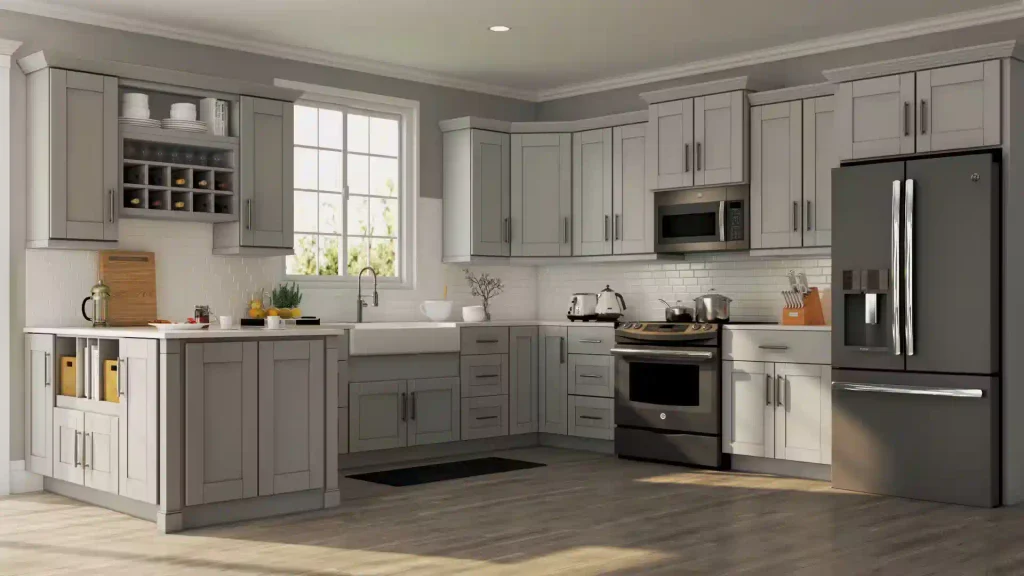
Color changes the personality of Shaker cabinetry much more than the underlying door shape. A white Shaker kitchen can feel bright and neutral, natural oak introduces visible grain and warmth, green adds an organic character, while navy or black creates significantly stronger contrast.
At Columbus Cabinets City, we select cabinet color in relation to the countertop, flooring, backsplash, room size, and lighting. The goal is not to choose the most popular Shaker color but to choose the version that gives the entire kitchen the right amount of warmth and visual weight.
Natural Wood Shaker Cabinets
Natural wood gives the simple Shaker profile more character because grain and color variation become visible across the rails, stiles, and center panel. White oak, maple, walnut, cherry, and hickory can each create a noticeably different result even when the door proportions remain the same.
We generally allow the wood to carry more of the visual movement in these kitchens. If the grain is pronounced, a quieter countertop and backsplash can keep the room from becoming overloaded with competing patterns.
Green and Blue Shaker Cabinets
Green and blue finishes introduce color while the simple Shaker frame keeps the cabinetry from becoming overly decorative. Sage and muted green can create a softer natural look, while navy or deep blue provides stronger contrast and more visual weight.
When cabinetry carries a strong color, we usually simplify one or more surrounding surfaces. Light countertops, controlled backsplash patterns, and coordinated hardware can help the cabinet color feel intentional instead of competing with several other dominant elements.
Dark Shaker Cabinets
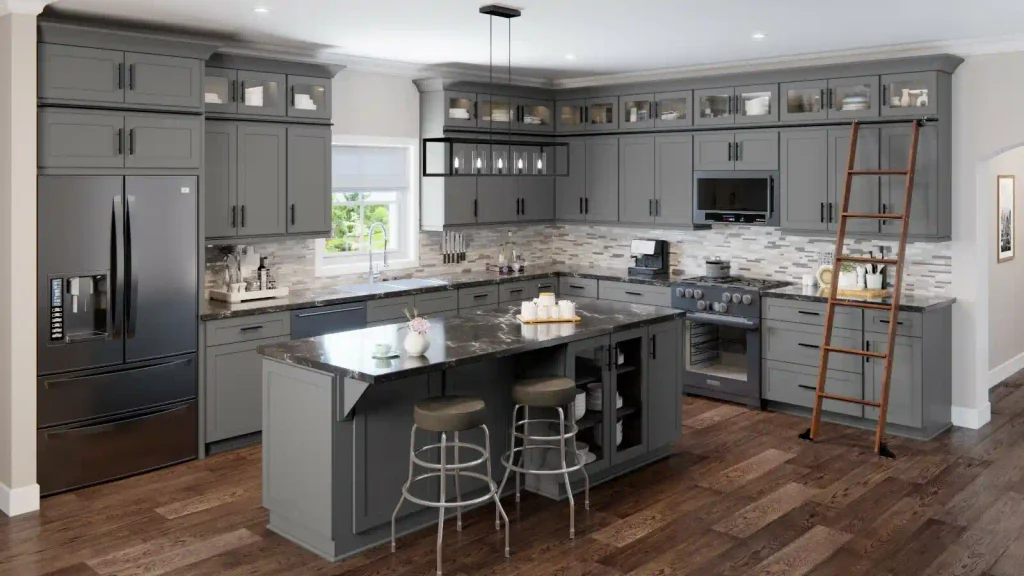
Black, charcoal, espresso, and other dark Shaker finishes emphasize the shadow created by the recessed panel and can give the cabinetry a more architectural appearance. They work particularly well on islands or in larger kitchens where there is enough light to balance the darker surfaces.
In smaller rooms, we usually introduce contrast through lighter countertops, backsplashes, walls, or flooring. The goal is to let the dark cabinetry create depth without making the entire kitchen visually heavy.
Best Countertops for Shaker Cabinets
Shaker cabinets do not require one specific countertop material. Quartz, granite, quartzite, marble, butcher block, and other surfaces can all work because the cabinet profile is simple enough to support either quiet or strongly patterned countertops.
At Columbus Cabinets City, we decide which material should carry more visual movement. Simple painted Shaker cabinetry can support dramatic veining, while natural wood or bold-colored cabinets may work better with a calmer countertop. Establishing that hierarchy helps the room feel coordinated rather than busy.
Quartz with Shaker Cabinets
Quartz gives us a wide range of design options because it is available in clean solid colors, subtle patterns, and marble-inspired surfaces. White Shaker cabinets can support everything from black quartz to heavily veined white designs, while natural wood cabinets often pair well with quieter light quartz.
The right combination depends more on undertone and pattern balance than on the Shaker style itself. We recommend testing the countertop directly against the cabinet door rather than selecting each finish independently.
Natural Stone with Shaker Cabinets
Granite, quartzite, and marble introduce natural variation that contrasts with the straight geometry of a Shaker door. Each slab can have different movement, so we look at how that pattern interacts with the amount of grain or color already present in the cabinetry.
A dramatic quartzite can become the focal point beside simple painted Shaker cabinets, while a quieter granite may support darker or more strongly grained cabinetry without making the overall design feel too busy.
Best Hardware for Shaker Cabinets
Shaker cabinets can work with knobs, bar pulls, cup pulls, edge pulls, and longer handles, but the hardware should support the proportions and design direction of the kitchen. The simple door frame gives the hardware enough visual space to influence whether the finished cabinetry feels contemporary, farmhouse, traditional, or transitional.
We often use brass or champagne bronze to add warmth, matte black for stronger contrast, and brushed nickel when a quieter metal is preferred. Pull size also matters, particularly on wide drawers where undersized hardware can look out of proportion.
Pros and Cons of Shaker Cabinets
Shaker cabinets work well for many kitchens because they balance simplicity and detail, but that does not mean they are the best answer for every homeowner. Their recessed profile gives cabinet fronts more depth than slab doors and is easier to coordinate than highly ornate styles.
The main tradeoff is that the recessed panel adds edges that need more cleaning, and the widespread use of Shaker means homeowners seeking a highly unusual cabinet style may prefer another profile. Understanding these practical advantages and limitations is more useful than treating popularity as proof that the style suits every kitchen.
Advantages of Shaker Cabinets
One of the strongest advantages of Shaker cabinetry is that it is available across a wide range of cabinet lines, materials, colors, and construction types. Homeowners can find versions in RTA, stock, semi-custom, frameless, framed, painted, stained, and custom cabinetry.
The simple profile also gives the surrounding design more freedom. Countertops, backsplash, flooring, lighting, and hardware can change significantly without requiring an equally dramatic change in the cabinet door itself.
Disadvantages of Shaker Cabinets
The recessed panel creates additional corners and horizontal edges where dust, cooking residue, and crumbs can collect, so Shaker doors take slightly more effort to clean than completely flat slab fronts.
Their popularity can also be a disadvantage for homeowners who want something less familiar. In those cases, changing the proportions, choosing slim Shaker, using natural wood, or selecting a less-common finish can make the kitchen feel more individual without abandoning the basic recessed-panel concept.
How Much Do Shaker Cabinets Cost?
Shaker cabinets do not have one standard price because the door profile is only one component of the cabinet. Material, box construction, drawer quality, finish, hardware, customization, accessories, assembly, and installation all influence the final project cost.
At Columbus Cabinets City, we recommend comparing complete cabinet lines rather than assuming two Shaker products are equivalent because the doors look similar. An entry-level RTA cabinet and a custom inset hardwood cabinet can both use Shaker doors while belonging to completely different price and construction categories.
How to Tell If Shaker Cabinets Are Good Quality
The appearance of the door alone does not tell you whether a Shaker cabinet is well built. We look at cabinet box construction, panel thickness, back support, shelves, drawer boxes, joinery, drawer slides, hinges, finish consistency, door construction, and warranty before judging the complete product.
This is especially important when comparing cabinets online because similar white Shaker doors can hide very different construction behind them. A specification sheet and physical sample usually provide far more useful information than a product photograph or the word “Shaker” in the cabinet name.
Are Shaker Cabinets Right for Your Kitchen?
Shaker cabinets are worth considering if you want some architectural detail on the cabinet fronts without committing to an ornate door style. They can work particularly well when the rest of the kitchen may change over time because the straightforward profile does not force countertops, hardware, lighting, and backsplash into one narrow design direction.
They are less appropriate when the goal is an extremely minimal flat-front kitchen or when you specifically want elaborate traditional cabinet detailing. At Columbus Cabinets City, we compare Shaker with alternative door styles in the context of the full kitchen rather than treating it as the automatic default.
Choose Shaker Cabinets by Construction, Not Just Appearance
Shaker cabinets are easy to recognize, but the recessed-panel profile is only the beginning of the decision. Frame width, material, cabinet construction, overlay, color, finish, hinges, drawers, and installation all influence how the cabinetry looks and performs once it is installed.
At Columbus Cabinets City, we help homeowners compare those details as part of the complete kitchen rather than choosing a cabinet from the door style alone. That approach makes it easier to select Shaker cabinetry that fits the room, the design direction, the storage needs, and the level of construction you actually want.
Frequently Asked Questions About Shaker Cabinets
Shaker style cabinets use a flat recessed center panel surrounded by a simple rectangular frame. The term describes the cabinet door profile rather than a specific color, material, brand, or cabinet box construction.
White Shaker cabinets are Shaker-style doors finished in a shade of white. The important design choice is the white undertone, since warm, neutral, and cooler whites can coordinate differently with countertops, floors, walls, and hardware.
Shaker cabinets may use solid hardwood, MDF, HDF, plywood, veneers, engineered panels, or combinations of these materials. The doors and cabinet boxes do not necessarily use the same material, so the complete specification should be reviewed when comparing quality.
Some are and some are not. Stained Shaker doors commonly use wood or wood veneer to show natural grain, while painted products may use MDF or HDF for a smoother surface. Cabinet boxes may use plywood or other engineered materials regardless of the door construction.
Shaker cabinets can work in either direction. Wider frames, inset doors, and traditional details create a more classic look, while slim frames, frameless construction, full-overlay doors, and minimal hardware can make Shaker cabinetry feel contemporary.
Yes. The profile continues to be widely used, although newer interpretations often use slimmer frames, natural wood, warmer colors, and cleaner full-overlay construction. Whether Shaker suits a particular kitchen still depends on the design rather than popularity alone.
They are relatively easy to maintain, but the recessed panel creates more edges and corners than a slab door. Regular wiping prevents dust and cooking residue from collecting along the lower rail and inside edges.
Shaker cabinets are available across many price ranges. RTA and stock versions can be relatively affordable, while semi-custom, hardwood, or inset Shaker cabinetry can cost much more. Construction and material quality influence price more than the door profile alone.
Shaker doors have a recessed center panel surrounded by a frame, while slab doors are flat from edge to edge. Shaker offers more depth and definition, while slab cabinetry creates a more minimal appearance.
Shaker doors use a flat recessed center panel, while raised-panel doors have a center section that projects forward and often include additional decorative shaping. Shaker cabinetry generally appears simpler and less formal.
Slim Shaker cabinets use the same recessed-panel concept as traditional Shaker doors but with narrower rails and stiles. The reduced frame width gives them a lighter, more contemporary appearance.
No. Shaker cabinets are still widely used, but current designs are moving toward slimmer frames, natural wood, warmer colors, full-overlay doors, and cleaner construction. The style itself remains relevant because its simple recessed-panel design can adapt to both classic and modern kitchens.